


Page 18 - IJAMD-1-2
P. 18
International Journal of AI for
            Materials and Design
                                                                                    Sustainable electronics using AI/ML


                         A


                         B


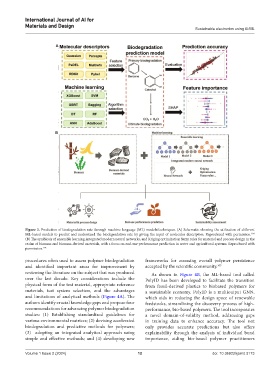
            Figure 3. Prediction of biodegradation rate through machine language (ML) models/techniques. (A) Schematic showing the utilization of different
            ML-based models to predict and understand the biodegradation rate by giving the input of molecular descriptors. Reproduced with permission.
                                                                                                            104
            (B) The symbiosis of ensemble learning, integrated modern neural networks, and Kriging optimization fuzzy rules for material and process design in the
            realm of biomass and biomass-derived materials, with a focus on end-use performance prediction in water and agricultural systems. Reproduced with
            permission. 105
            procedures often used to assess polymer biodegradation   frameworks for assessing overall polymer persistence
            and identified important areas  for improvement  by   accepted by the scientific community. 105
            reviewing the literature on the subject that was produced   As shown in  Figure  4B, the ML-based tool called
            over the last decade. Key considerations include the   PolyID has been developed to facilitate the transition
            physical form of the test material, appropriate reference   from fossil-derived plastics to biobased polymers for
            materials, test system selection, and the advantages   a sustainable economy. PolyID is a multioutput GNN,
            and limitations of analytical methods (Figure  4A). The   which  aids  in reducing the design space of renewable
            authors identify crucial knowledge gaps and propose four   feedstocks, streamlining the discovery process of high-
            recommendations for advancing polymer biodegradation   performance, bio-based polymers. The tool incorporates
            studies: (1) Establishing standardized guidelines for   a  novel  domain-of-validity  method,  addressing  gaps
            various environmental matrices; (2) devising accelerated   in training data to enhance accuracy. The tool not
            biodegradation  and  predictive  methods  for  polymers;   only provides accurate predictions but also offers
            (3)    adopting  an  integrated  analytical  approach  using   explainability through the analysis of individual bond
            simple and effective methods; and (4) developing new   importance, aiding bio-based polymer practitioners


            Volume 1 Issue 2 (2024)                         12                             doi: 10.36922/ijamd.3173

