


Page 32 - IJAMD-1-2
P. 32
International Journal of AI for
            Materials and Design
                                                                                      AI-driven quality assurance in AM


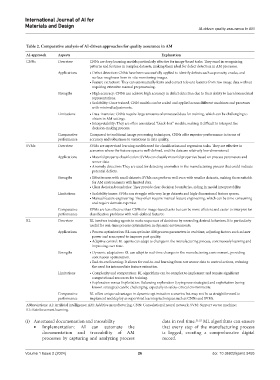
            Table 2. Comparative analysis of AI‑driven approaches for quality assurance in AM
            AI‑approach   Aspects                                     Explanation
            CNNs          Overview     CNNs are deep learning models particularly effective for image-based tasks. They excel in recognizing
                                       patterns and features in complex datasets, making them ideal for defect detection in AM processes.
                          Applications  •  Defect detection: CNNs have been successfully applied to identify defects such as porosity, cracks, and
                                        surface roughness from in-situ monitoring images.
                                       •  Feature extraction: They can automatically learn and extract relevant features from raw image data without
                                        requiring extensive manual preprocessing.
                          Strengths    •  High accuracy: CNNs can achieve high accuracy in defect detection due to their ability to learn hierarchical
                                        representations.
                                       •  Scalability: Once trained, CNN models can be scaled and applied across different machines and processes
                                        with minimal adjustments.
                          Limitations  •  Data‑intensive: CNNs require large amounts of annotated data for training, which can be challenging to
                                        obtain in AM settings.
                                       •  Interpretability: They are often considered “black‑box” models, making it difficult to interpret the
                                        decision-making process.
                          Comparative   Compared to traditional image processing techniques, CNNs offer superior performance in terms of
                          performance  accuracy and robustness to variations in data quality.
            SVMs          Overview     SVMs are supervised learning models used for classification and regression tasks. They are effective in
                                       scenarios where the feature space is well-defined, and the data are relatively low-dimensional.
                          Applications  •  Material property classification: SVMs can classify material properties based on process parameters and
                                        sensor data.
                                       •  Anomaly detection: They are used for detecting anomalies in the manufacturing process that could indicate
                                        potential defects.
                          Strengths    •  Effectiveness with small datasets: SVMs can perform well even with smaller datasets, making them suitable
                                        for AM environments with limited data.
                                       • Clear decision boundaries: They provide clear decision boundaries, aiding in model interpretability.
                          Limitations  • Scalability issues: SVMs can struggle with very large datasets and high‑dimensional feature spaces.
                                       •  Manual feature engineering: They often require manual feature engineering, which can be time‑consuming
                                        and require domain expertise.
                          Comparative   SVMs are less effective than CNNs for image-based tasks but can be more efficient and easier to interpret for
                          performance  classification problems with well-defined features.
            RL            Overview     RL involves training agents to make sequences of decisions by rewarding desired behaviors. It is particularly
                                       useful for real-time process optimization in dynamic environments.
                          Applications  •  Process optimization: RL can optimize AM process parameters in real time, adjusting factors such as laser
                                        power and scan speed to improve part quality.
                                       •  Adaptive control: RL agents can adapt to changes in the manufacturing process, continuously learning and
                                        improving over time.
                          Strengths    •  Dynamic adaptation: RL can adapt to real‑time changes in the manufacturing environment, providing
                                        continuous optimization.
                                       •  End‑to‑end learning: It allows for end‑to‑end learning from raw sensor data to control actions, reducing
                                        the need for intermediate feature extraction.
                          Limitations  •  Complexity and computation: RL algorithms can be complex to implement and require significant
                                        computational resources for training.
                                       •  Exploration versus Exploitation: Balancing exploration (trying new strategies) and exploitation (using
                                        known strategies) can be challenging, especially in safety-critical environments.
                          Comparative   RL offers unique advantages in dynamic optimization scenarios but may not be as straightforward to
                          performance  implement and deploy as supervised learning techniques such as CNNs and SVMs.
            Abbreviations: AI: Artificial intelligence; AM: Additive manufacturing, CNN: Convolutional neural network; SVM: Support vector machine;
            RL: Reinforcement learning.
            (i)  Automated documentation and traceability             data in real time. 21,22  ML algorithms can ensure
               •   Implementation: AI can automate the                that every step of the manufacturing process
                   documentation and traceability of AM               is logged, creating a comprehensive digital
                   processes by capturing and analyzing process       record.


            Volume 1 Issue 2 (2024)                         26                             doi: 10.36922/ijamd.3455

