


Page 31 - IJAMD-1-2
P. 31
International Journal of AI for
            Materials and Design
                                                                                      AI-driven quality assurance in AM


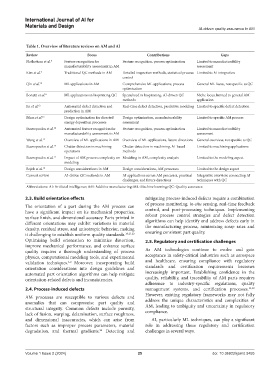
            Table 1. Overview of literature reviews on AM and AI
            Review                    Focus                     Contributions                  Gaps
            Plathottam et al. 5  Feature recognition for   Feature recognition, process optimization  Limited to manufacturability
                            manufacturability assessment in AM                       assessment
            Kim et al. 9    Traditional QC methods in AM  Detailed inspection methods, statistical process  Limited to AI integration
                                                     control
            Qin et al. 10   ML applications in AM    Comprehensive ML applications, process   General ML focus, not specific to QC
                                                     optimization
            Bonatti et al. 11  ML applications in bioprinting QC  Specialized in bioprinting, AI-driven QC   Niche focus, limited to general AM
                                                     methods                         application
            Jin et al. 12   Automated defect detection and   Real-time defect detection, predictive modeling Limited to specific defect detection
                            prediction in AM
            Bikas et al. 13  Design optimization for directed   Design optimization, manufacturability   Limited to specific AM process
                            energy deposition processes  assessment
            Stavropoulos et al. 14  Automated feature recognition for   Feature recognition, process optimization  Limited to manufacturability
                            manufacturability assessment in AM                       assessment
            Wang et al. 15  Overview of ML applications in AM  Overview of ML applications, future directions  General overview, not specific to QC
            Stavropoulos et al. 16  Chatter detection in machining   Chatter detection in machining, AI-based   Limited to machining applications
                            operations               methods
            Stavropoulos et al. 17  Impact of AM process complexity on  Modeling in AM, complexity analysis  Limited to the modeling aspect
                            modeling
            Rojek et al. 19  Design considerations in AM  Design considerations, AM processes  Limited to the design aspect
            Current review  AI-driven QC methods in AM  AI applications across AM processes, practical   Integrative overview, connecting AI
                                                     challenges, and future directions  techniques with QC
            Abbreviations: AI: Artificial intelligence; AM: Additive manufacturing; ML: Machine learning; QC: Quality assurance.

            2.3. Build orientation effects                     mitigating process-induced defects require a combination
            The orientation of a part during the AM process can   of process monitoring, in-situ sensing, real-time feedback
            have a significant impact on its mechanical properties,   control, and post-processing techniques. Implementing
            surface finish, and dimensional accuracy. Parts printed in   robust process control strategies  and  defect  detection
            different  orientations may  exhibit  variations  in material   algorithms can help identify and address defects early in
            density, residual stress, and anisotropic behavior, making   the manufacturing process, minimizing scrap rates and
            it challenging to establish uniform quality standards. 18,21,23    ensuring consistent part quality.
            Optimizing build orientation to minimize distortion,   2.5. Regulatory and certification challenges
            improve mechanical performance, and enhance surface
            quality requires a thorough understanding of process   As AM technologies continue to evolve and gain
            physics, computational modeling tools, and experimental   acceptance in safety-critical industries such as aerospace
            validation techniques.  Moreover, incorporating build   and healthcare, ensuring compliance with regulatory
                              1,2
            orientation considerations into design guidelines and   standards and certification requirements becomes
            automated part orientation algorithms can help mitigate   increasingly important. Establishing confidence in the
            orientation-related defects and inconsistencies.   quality, reliability, and traceability of AM parts requires
                                                               adherence  to industry-specific regulations, quality
            2.4. Process-induced defects                       management  systems,  and  certification  processes. 11,12
            AM  processes  are  susceptible  to  various  defects  and   However, existing regulatory frameworks may not fully
            anomalies that can compromise part quality and     address the unique characteristics and complexities of
            structural integrity. Common defects include porosity,   AM, leading to ambiguity and uncertainty in regulatory
            lack of fusion, warping, delamination, surface roughness,   compliance.
            and dimensional inaccuracies, which can arise from   AI, particularly ML techniques, can play a significant
            factors such as improper process parameters, material   role in addressing these regulatory and certification
            degradation,  and  thermal  gradients.   Detecting and   challenges in several ways.
                                           26


            Volume 1 Issue 2 (2024)                         25                             doi: 10.36922/ijamd.3455

