


Page 11 - IJAMD-2-2
P. 11
International Journal of AI for
            Materials and Design                                                  AI-driven material development for AM


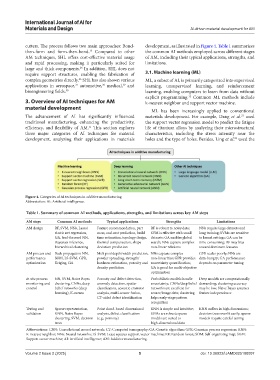
            cutters. The process follows two main approaches: Bond-  development, as illustrated in Figure 4. Table 1 summarizes
            then-form and  form-then-bond.   Compared  to  other   the common AI methods employed across different stages
                                       13
            AM techniques,  SHL offers  cost-effective material usage   of AM, including their typical applications, strengths, and
            and rapid processing, making it particularly suited for   limitations.
            large and thick components.  In addition, SHL does not
                                   26
            require support structures, enabling the fabrication of   3.1. Machine learning (ML)
            complex geometries directly.  SHL has also shown various   ML, a subset of AI, is primarily categorized into supervised
                                   26
            applications in aerospace,  automotive,  medical,  and   learning, unsupervised learning, and reinforcement
                                 27
                                            28
                                                     29
            bioengineering fields. 30                          learning, enabling computers to learn from data without
                                                               explicit programming.   Common  ML  methods  include
                                                                                 32
            3. Overview of AI techniques for AM                k-nearest neighbor and support vector machine.
            material development
                                                                 ML has been increasingly applied to conventional
            The advancement of AI has significantly influenced   materials development. For example, Dang  et al.  used
                                                                                                        33
            traditional manufacturing, enhancing  the productivity,   the support vector regression model to predict the fatigue
            efficiency, and flexibility of AM.  This section explores   life of titanium alloys by analyzing their microstructural
                                       31
            three major categories of AI techniques for material   characteristics, including the stress intensity near the
            development,  analyzing  their  applications  in  materials   holes and the type of holes. Besides, Ling et al.  used the
                                                                                                     34


            Figure 4. Categories of AI techniques in additive manufacturing
            Abbreviation: AI: Artificial intelligence.

            Table 1. Summary of common AI methods, applications, strengths, and limitations across key AM steps
            AM steps     Common AI methods    Typical applications      Strengths            Limitations
            AM design   RF, SVM, NNs, Lasso/  Feature recommendation, part   RF is robust to noisy data;   NNs require large datasets and
                        elastic net regression,   mass, and cost prediction, build   SVM is effective with small   long training; SVMs are sensitive
                        GA, feed-forward NN,   time estimation, topology design,  datasets; GA enables global   to kernel settings; GA can be
                        Bayesian inference,   thermal compensation, shape   search; NNs capture complex  time-consuming; RF may bias
                        hierarchical clustering  deviation prediction  non-linear relations  toward dominant features
            AM process and  Back propagation NN,   Melt pool depth/width prediction,  NNs capture complex   GPR scales poorly; NNs are
            performance   SOM, LS-SVM, GPR,   powder spreading, strength/  non-linearities; GPR provides  data-hungry; GA performance
            optimization  Kriging, GA     hardness estimation, porosity and  uncertainty quantification;   depends on parameter tuning
                                          density prediction     GA is good for multi-objective
                                                                 optimization
            In situ process   NN, SVM, Naive Bayes   Porosity and defect detection,   Probabilistic models handle   Deep models are computationally
            monitoring and   clustering, CNNs, deep   anomaly detection, spatter   uncertainty; CNNs/deep belief  demanding; clustering accuracy
            control     belief networks (deep   classification, acoustic emission   networks are excellent for   may be low; Naive Bayes assumes
                        learning), K-means  analysis, multi-sensor fusion,   sensor/image data; clustering  feature independence
                                          CT-aided defect identification  helps early-stage pattern
                                                                 recognition
            Testing and   Sparse representation,   Point cloud-based dimensional   KNN is simple and intuitive;   KNN suffers in high dimensions;
            validation  KNN, Naïve Bayes   analysis, defect classification    SVMs are robust; sparse   decision trees overfit easily; sparse
                        clustering, SVM, decision  (e.g., porosity)  models are suited to   models require careful tuning
                        trees                                    high-dimensional data
            Abbreviations: CNN: Convolutional neural network; CT: Computed tomography; GA: Genetic algorithm; GPR: Gaussian process regression; KNN:
            K-nearest neighbor; NNs: Neural networks; LS-SVM: Least squares support vector machine; RF: Random forest; SOM: Self-organizing map; SVM:
            Support vector machine; AI: Artificial intelligence; AM: Additive manufacturing.


            Volume 2 Issue 2 (2025)                         5                         doi: 10.36922/IJAMD025100007

