


Page 15 - IJAMD-2-2
P. 15
International Journal of AI for
            Materials and Design                                                  AI-driven material development for AM


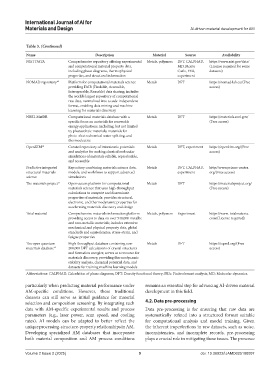
            Table 3. (Continued)
            Name                          Description             Material      Source         Availability
            NIST DATA         Comprehensive repository offering experimental   Metals, polymers  DFT, CALPHAD,   https://www.nist.gov/data/
                              and computational material property data,      MD, Monte    (License required for some
                              including phase diagrams, thermophysical       Carlo, FEA,   datasets)
                              properties, and structural information         experiment
            NOMAD repository 49  Platform for computational materials science   Metals  DFT  https://nomad-lab.eu/(Free
                              providing FAIR (Findable, Accessible,                       access)
                              Interoperable, Reusable) data sharing; includes
                              the world’s largest repository of computational
                              raw data, normalized into a code-independent
                              format, enabling data mining and machine
                              learning for materials discovery
            NREL MatDB        Computational materials database with a   Metals  DFT       https://materials.nrel.gov/
                              specific focus on materials for renewable                   (Free access)
                              energy applications, including, but not limited
                              to, photovoltaic materials, materials for
                              photo-electrochemical water splitting, and
                              thermoelectric
            OpenKIM 50        Curated repository of interatomic potentials   Metals  DFT, experiment  https://openkim.org/(Free
                              and analytics for making classical molecular                access)
                              simulations of materials reliable, reproducible,
                              and accessible
            Predictive integrated   Repository combining materials science data,   Metals  DFT, CALPHAD,   http://www.prisms-center.
            structural materials   models, and workflows to support advanced   experiment  org/(Free access)
            science           simulations
            The materials project 51  Open-access platform for computational   Metals  DFT  https://materialsproject.org/
                              materials science that uses high-throughput                 (Free access)
                              calculations to compute and disseminate
                              properties of materials; provides structural,
                              electronic, and thermodynamic properties for
                              accelerating materials discovery and design
            Total material    Comprehensive materials information platform   Metals, polymers  Experiment  https://www. totalmateria.
                              providing access to data on over 540,000 metallic           com/(License required)
                              and non-metallic materials; includes extensive
                              mechanical and physical property data, global
                              standards and equivalencies, stress-strain, and
                              fatigue properties
            The open quantum   High-throughput database containing over   Metals  DFT     https://oqmd.org/(Free
            materials database 52  200,000 DFT calculations of crystal structures         access)
                              and formation energies; serves as a resource for
                              materials discovery, providing thermodynamic
                              stability analysis, chemical potential data, and
                              datasets for training machine learning models
            Abbreviations: CALPHAD: Calculation of phase diagrams; DFT: Density functional theory; FEA: Finite element analysis; MD: Molecular dynamics.

            particularly when predicting material performance under   remains an essential step for advancing AI-driven material
            AM-specific conditions. However,  these traditional   development in this field.
            datasets can still serve as initial guidance for material
            selection and composition screening. By integrating such   4.2. Data pre-processing
            data  with AM-specific experimental results and process   Data pre-processing is for ensuring that raw data are
            parameters  (e.g.,  laser  power,  scan  speed,  and  cooling   systematically refined into a structured format suitable
            rates), AI models can be adapted to better reflect the   for computational analysis and model training. Given
            unique processing-structure-property relationships in AM.   the inherent imperfections in raw datasets, such as noise,
            Developing  specialized  AM  databases  that  incorporate   inconsistencies,  and incomplete records,  pre-processing
            both material composition and AM process conditions   plays a crucial role in mitigating these issues. The presence


            Volume 2 Issue 2 (2025)                         9                         doi: 10.36922/IJAMD025100007

