


Page 20 - IJAMD-2-2
P. 20
International Journal of AI for
            Materials and Design                                                  AI-driven material development for AM


            From fatigue strength modeling to process parameter   driven learning, will be essential for further improving
            optimization, AI has proven to be a powerful tool in   predictive accuracy and expanding the applicability of AI
            enhancing microstructural control and mechanical property   in AM alloy design.
            refinement. Despite these advancements, challenges
            remain in data completeness, model interpretability,   5.2. Polymer materials for AM
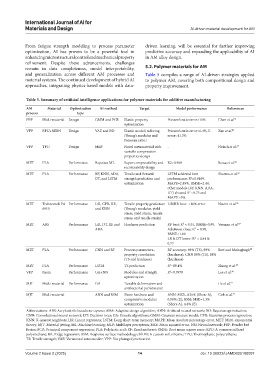
            and generalization across different AM processes and   Table 5 compiles a range of AI-driven strategies applied
            material systems. The continued development of hybrid AI   to polymer AM, covering both compositional design and
            approaches, integrating physics-based models with data-  property improvement.


            Table 5. Summary of artificial intelligence applications for polymer materials for additive manufacturing
            AM       Material  Optimization   AI method     Target          Model performance     References
            process               type
            PBF    Multi-material  Design  GMM and PCR  Elastic property   Poisson’s ratio error≈16%  Chen et al. 81
                                                      optimization
            VPP    RPU+SilDN  Design     VAE and BO   Elastic moduli tailoring   Poisson’s ratio error≈6.4%, E   Xue et al. 82
                                                      (Young’s modulus and   error≈11.3%
                                                      Poisson’s ratio)
            VPP    TPU        Design     MLP          Novel metamaterial with   -             Fleisch et al. 83
                                                      variable compression
                                                      properties design
            MET    PLA        Performance  Bayesian ML  Super-compressibility and  R2≈0.988   Bessa et al. 84
                                                      recoverability design
            MET    PLA        Performance  RF, KNN, ADA,   Tensile and flexural   LSTM achieved best   Sharma et al. 85
                                         DT, and LSTM  strength prediction and   performance: R =0.9169,
                                                                                  2
                                                      optimization      MAPE=2.85%, RMSE=2.44;
                                                                        other models (RF, KNN, ADA,
                                                                        DT) showed R  <0.75 and
                                                                                  2
                                                                        MAPE >5%.
            MET    Technomelt PA  Performance  LiR, GPR, RR,   Tensile property prediction  LiR/RR best:  <10% error  Nasrin et al. 86
                   6910                  and KNN      (Young’s modulus, yield
                                                      stress, yield strain, tensile
                                                      stress, and tensile strain)
            MET    ABS        Performance  LiR, DT, RF, and  Hardness prediction  RF best: R² ≈ 0.91, RMSE≈0.99,  Veeman et al. 87
                                         ADA                            AdaBoost close: R² ≈ 0.90,
                                                                        RMSE≈1.09
                                                                        LR & DT lower: R² ≈ 0.84 &
                                                                        0.77
            MET    PLA        Performance  CNN and RF  Process parameters–  RF accuracy: 94% (TS), 89%   Butt and Mohaghegh 88
                                                      property correlation    (hardness); CNN 88% (TS), 88%
                                                      (TS and hardness)  (hardness)
            MET    PLA        Performance  LSTM       TS prediction     R =89.4%              Zhang et al. 89
                                                                         2
            VPP    Resin      Performance  GA+NN      Modulus and strength   R =0.9978        Lee et al. 90
                                                                         2
                                                      optimization
            MJT    Multi-material  Performance  GA    Tunable deformation and   -             He et al. 91
                                                      antibacterial performance
            MJT    Multi-material        ANN and RSM  Shore hardness and   ANN: MSE=0.36% (Shore A),   Goh et al. 92
                                                      compressive modulus   0.98% (E); RSM: MSE=1.3%
                                                      optimization      (Shore A), 4.4% (E)
            Abbreviations: ABS: Acrylonitrile butadiene styrene; ADA: Adaptive design algorithm; ANN: Artificial neural network; BO: Bayesian optimization;
            CNN: Convolutional neural network; DT: Decision trees; GA: Genetic algorithms; GMM: Gaussian mixture model; GPR: Gaussian process regression;
            KNN: K-nearest neighbors; LiR: Linear regression; LSTM: Long short-term memory; MAPE: Mean absolute percentage error; MET: Multi-exponential
            theory; MJT: Material jetting; ML: Machine learning; MLP: Multilayer perceptron; MSE: Mean squared error; NN: Neural network; PBF: Powder bed
            fusion; PCR: Principal component regression; PLA: Polylactic acid; RF: Random forest; RMSE: Root mean square error; RPU: A commercial hard
            polyurethane; RR: Ridge regression; RSM: Response surface methodology; SilDN: A custom soft silicone; TPU: Thermoplastic polyurethane;
            TS: Tensile strength; VAE: Variational autoencoder; VPP: Vat photopolymerization.


            Volume 2 Issue 2 (2025)                         14                        doi: 10.36922/IJAMD025100007

