


Page 19 - IJAMD-2-2
P. 19
International Journal of AI for
            Materials and Design                                                  AI-driven material development for AM


            structural homogeneity and stability. Mechanical property   within PSP relationships, allowing for improved process
            optimization, on the other hand, primarily focuses on the   parameter selection to minimize defects and enhance
            enhancement of properties, including strength, hardness,   mechanical performance. The model showed strong
            ductility, and fracture toughness, which are typically   agreement with experimental results, suggesting reliable
            realized through appropriate microstructural and process   prediction accuracy.
            control.                                             In addition, Gaussian process-based models have been
              Recent advancements in AI-driven methodologies   explored to optimize  process  parameters  for improved
                                                                                                80
            have enabled the establishment of correlations between   mechanical  performance.  Tapia  et al.   developed  a
            processing parameters and microstructural characteristics   Gaussian  process-based surrogate  modeling  framework
            in AM. By leveraging ML models trained on experimental   to predict melt pool depth in LPBF of 316L stainless steel,
            and  computational  datasets, AI  enables more  accurate   thereby identifying processing windows that enhance
            predictions of microstructural evolution and mechanical   part quality. Their approach enabled the classification of
            properties under varying process conditions. For example,   conduction-mode and keyhole-mode melting regimes,
            Awd et al.  integrated mechanistic ML with physics-based   which directly affect the microstructure and, consequently,
                    63
            models to predict and optimize the fatigue strength of   the mechanical properties of AM components.
                                                                                60
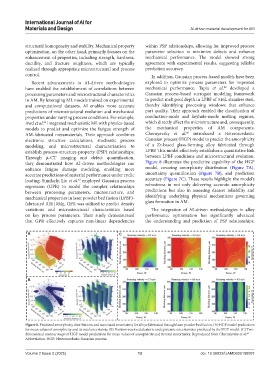
            AM-fabricated metamaterials. Their approach combines   Chernyavsky  et al.  introduced a  Heteroscedastic
            electronic structure calculations, stochastic process   Gaussian process (HGP) model to predict the amorphicity
            modeling, and microstructural characterization to   of a Zr-based glass-forming alloy fabricated through
            establish process-structure-property (PSP) relationships.   LPBF. This model effectively establishes a quantitative link
            Through  μ-CT imaging and defect quantification,   between LPBF conditions and microstructural evolution.
            they  demonstrated  how  AI-driven  methodologies  can   Figure  8 illustrates the predictive capability of the HGP
            enhance fatigue damage modeling, enabling more     model, covering amorphicity distribution (Figure  7A),
            accurate predictions of material performance under cyclic   uncertainty quantification (Figure  7B), and prediction
            loading. Similarly, Liu et al.  employed Gaussian process   accuracy (Figure 7 C). These results highlight the model’s
                                  62
            regression (GPR) to model the complex relationships   robustness in not only delivering accurate amorphicity
            between processing parameters, microstructure, and   predictions but also in assessing dataset reliability and
            mechanical properties in laser powder bed fusion (LPBF)-  identifying underlying physical mechanisms governing
            fabricated AlSi10Mg. GPR was utilized to predict density   glass formation in AM.
            variations and microstructural characteristics based   The integration of AI-driven methodologies in alloy
            on key process parameters. Their study demonstrated   performance optimization has significantly advanced
            that  GPR  effectively  captures  non-linear  dependencies   the  understanding  and prediction of PSP  relationships.

             A                                      C


             B


            Figure 8. Predicted amorphicity distributions and associated uncertainty for alloys fabricated through laser powder bed fusion. (A) HGP model predictions
            for mean values of amorphicity and its total uncertainty. (B) Position-resolved aleatoric and epistemic uncertainties predicted by the HGP model. (C) Two-
            dimensional contour maps of HGP model predictions for mean values of amorphicity and its total uncertainty. Reproduced from Chernyavsky et al. 60
            Abbreviation: HGP: Heteroscedastic Gaussian process.


            Volume 2 Issue 2 (2025)                         13                        doi: 10.36922/IJAMD025100007

