


Page 22 - IJAMD-2-2
P. 22
International Journal of AI for
            Materials and Design                                                  AI-driven material development for AM


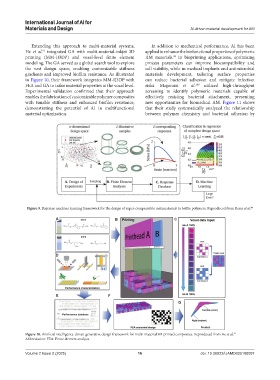
              Extending  this  approach  to  multi-material  systems,   In  addition  to  mechanical  performance,  AI  has  been
            He  et  al.  integrated GA with multi-material-inkjet 3D   applied to enhance the biofunctional properties of polymeric
                   91
            printing (MM-IJ3DP) and voxel-level finite element   AM materials.   In bioprinting applications, optimizing
                                                                           99
            modeling. The GA served as a global search tool to explore   process parameters can improve biocompatibility and
            the vast design space, enabling customizable stiffness   cell viability, while in medical implants and antimicrobial
            gradients and improved biofilm resistance. As illustrated   materials development, tailoring surface properties
            in Figure 10, their framework integrates MM-IJ3DP with   can reduce bacterial adhesion and mitigate infection
            FEA and GA to tailor material properties at the voxel level.   risks.  Magennis  et al.  utilized high-throughput
                                                                                    100
            Experimental validation confirmed that their approach   screening to identify polymeric materials capable of
            enables the fabrication of customizable polymer composites   effectively resisting bacterial attachment, presenting
            with tunable stiffness and enhanced biofilm resistance,   new opportunities for biomedical AM.  Figure  11  shows
            demonstrating the potential of AI in multifunctional   that their study systematically analyzed the relationship
            material optimization.                             between polymer chemistry and  bacterial adhesion  by


             Figure 9. Bayesian machine learning framework for the design of super-compressible metamaterials in brittle polymers. Reproduced from Bessa et al. 84
                         A                        B                        C


                         D


                         E                     F
                                                                             G


            Figure 10. Artificial intelligence-driven generative design framework for multi-material 3D-printed composites. Reproduced from He et al. 91
            Abbreviation: FEA: Finite element analysis.


            Volume 2 Issue 2 (2025)                         16                        doi: 10.36922/IJAMD025100007

