


Page 87 - IJAMD-2-2
P. 87
International Journal of AI for
            Materials and Design                                                        Fruit image detection using AI


            feature values into the same range. This prevents any single   2.3. Comparison of kernel functions
            feature from having too much influence over the model’s   The different kernel functions were benchmarked against
            performance.
                                                               each other based on their performance in efficiently
            2.2.2. Training the model                          classifying the fruits. This evaluation utilized several
                                                               performance metrics, including accuracy, precision, recall,
            To train the model, the system splits the entire dataset into   and F1 score, all derived from confusion matrix analyses.
            two parts: One for training and one for testing. It used 70%
            of the data in training the model and kept the other 30%   2.3.1. Confusion matrix method
            to test the training efficiency. Then, the SVM model was
            trained using the selected features. The study also used   One of the most effective approaches for evaluating the
            kernel functions to transform the feature space, which   performance of the trained classification model is the
            helped the model capture non-linear relationships.  confusion matrix. In this study, the confusion matrix
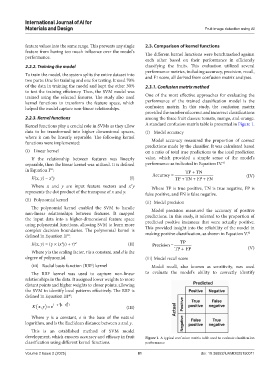
                                                               provided the number of correct and incorrect classifications
            2.2.3. Kernel functions                            among the three fruit classes: tomato, mango, and orange.

            Kernel functions play a crucial role in SVMs as they allow   A standard confusion matrix table is presented in Figure 1.
            data to be transformed into higher dimensional spaces,   (i)  Model accuracy
            where it can be linearly separable. The following kernel
            functions were implemented:                          Model accuracy measured the proportion of correct
                                                               predictions made by the classifier. It was calculated based
            (i)  Linear kernel                                 on a ratio of total true predictions to the total prediction
              If the relationship between features was linearly   value, which provided a simple sense of the model’s
            separable, then the linear kernel was utilized. It is defined   performance as indicated in Equation IV. 41
            in Equation I :                                                     TP + TN
                      38
                                                                  Accuracy =                              (IV)
              K(x, y) = x y                             (I)                TP + TN + FP + FN
                       T
              Where  x and  y are input feature vectors and  x y   Where TP is true positive, TN is true negative, FP is
                                                         T
            represents the dot product of the transpose of x and y.  false positive, and FN is false negative.
            (ii)  Polynomial kernel                            (ii)  Model precision
              The polynomial kernel enabled the SVM to handle    Model precision measured the accuracy of positive
            non-linear relationships between features. It mapped   predictions. In this study, it referred to the proportion of
            the input data into a higher-dimensional feature space   predicted positive instances that were actually positive.
            using polynomial functions, allowing SVM to learn more   This provided insight into the reliability of the model in
            complex decision boundaries. The polynomial kernel is                                         42
            defined in Equation II :                           making positive classification, as shown in Equation V.
                             39
              K(x, y) = (γ × (x y) + r) d              (II)       Precision =  TP                         (V)
                           T
              Where γ is the scaling factor, r is a constant, and d is the   TP  +  FP
            degree of polynomial.                              (iii) Model recall score
              (iii)  Radial basis function (RBF) kernel          Model recall, also known as sensitivity, was used
              The RBF kernel was used to capture non-linear    to evaluate the model’s ability to correctly identify
            relationships in the data. It assigned lower weights to more
            distant points and higher weights to closer points, allowing
            the SVM to identify local patterns effectively. The RBF is
            defined in Equation III :
                              40
               K ( ,xy ) e=  (    * x   y )−γ  −  2    (III)

              Where  γ is a constant,  e is the base of the natural
            logarithm, and is the Euclidean distance between x and y.
              This is an established method of SVM model
            development, which ensures accuracy and efficacy in fruit   Figure 1. A typical confusion matrix table used to evaluate classification
            classification using different kernel functions.   performance

            Volume 2 Issue 2 (2025)                         81                        doi: 10.36922/IJAMD025150011

