


Page 90 - IJAMD-2-2
P. 90
International Journal of AI for
            Materials and Design                                                        Fruit image detection using AI


            is left unclassified by the system, thereby maximizing the   Table 2. Confusion matrix for fruit classification
            efficiency of the sorting process.
                                                               Fruit type     Predicted   Predicted   Predicted
              The F1 score balances the measure between precision              tomato      mango      orange
            and recall, further underscores the performance of a   Actual tomato  85        10          5
            model. Using combined features, an F1 score of 86.5%   Actual mango  12         85          3
            was observed, demonstrating an effective balance between   Actual orange  8      2          90
            precision and recall. This result highlights the robustness of
            the classification framework and its suitability for reliable
            fruit sorting.
              In summary, the results show that the fruit classification
            system performed significantly better when using a
            comprehensive set of features. The findings underscore
            the importance of effective feature selection in achieving
            high accuracy, precision, recall, and F1 scores, all of which
            contribute to a reliable and efficient automated fruit sorting
            mechanism.

            3.2. Confusion matrix for fruit classification
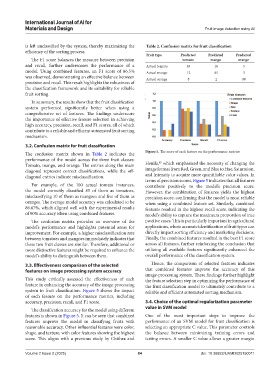
            The confusion matrix shown in  Table 2 indicates the   Figure 5. The score of each feature on the performance metrics
            performance of the model across the three fruit classes:
                                                                     45
            Tomato, mango, and orange. The entries along the main   Henila,  which emphasized the necessity of changing the
            diagonal represent correct classifications, while the off-  image format from Red, Green, and Blue to Hue, Saturation,
            diagonal entries indicate misclassification.       and Intensity to acquire more quantifiable color values. In
                                                               terms of precision scores, Figure 5 indicates that all features
              For  example,  of  the  100  actual  tomato  instances,   contribute positively to the model’s precision score.
            the model correctly classified 85 of them as tomatoes,   However, the combination of features yields the highest
            misclassifying 10 of them as mangoes and five of them as   precision score, confirming that the model is most reliable
            oranges. The average model accuracy was calculated to be   when using a combined feature set. Similarly, combined
            86.67%, which aligned well with the experimental results   features resulted in the highest recall score, indicating the
            of 90% accuracy when using combined features.      model’s ability to capture the maximum proportion of true
              The  confusion  matrix  provides  an  overview  of  the   positive cases. This is particularly important in agricultural
            model’s  performance  and highlights  potential areas  for   applications, where accurate identification of fruit types can
            improvement. For example, a higher misclassification rate   directly impact sorting efficiency and marketing decisions.
            between tomatoes and mangoes immediately indicates that   Finally, the combined features resulted in the best F1 score
            these two fruit classes are similar. Therefore, additional or   across all features, further reinforcing the conclusion that
            more distinctive features might be required to enhance the   utilizing all available features significantly enhanced the
            model’s ability to distinguish between them.       overall performance of the classification system.

            3.3. Effectiveness comparison of the selected        Hence, the comparison of selected features indicates
            features on image processing system accuracy       that combined features improve the accuracy of this
                                                               image-processing system. These findings further highlight
            This study critically assessed the effectiveness of each   the feature selection step in optimizing the performance of
            feature in enhancing the accuracy of the image processing   the fruit classification model to ultimately contribute to a
            system in fruit classification.  Figure  5 shows the impact   reliable and efficient automated sorting mechanism.
            of each feature on the performance metrics, including
            accuracy, precision, recall, and F1 score.         3.4. Choice of the optimal regularization parameter

              The classification accuracy for the model using different   value in SVM model
            features is shown in Figure 5. It can be seen that combined   One of the most important steps to improve the
            features improve the model in classifying fruits with   performance of an SVM model for fruit classification is
            reasonable accuracy. Other influential features were color,   selecting an appropriate C value. This parameter controls
            shape, and texture, with color features showing the highest   the balance between minimizing training errors and
            score.  This  aligns  with  a  previous  study  by  Chithra  and   testing errors. A smaller C value allows a greater margin


            Volume 2 Issue 2 (2025)                         84                        doi: 10.36922/IJAMD025150011

