


Page 22 - IJAMD-2-3
P. 22
International Journal of AI for
            Materials and Design                                                   AI applications in composite materials


             A


             B                                                C


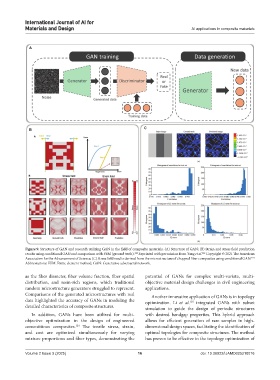
            Figure 9. Structure of GAN and research utilizing GAN in the field of composite materials. (A) Structure of GAN; (B) Strain and stress field prediction
            results using conditional GAN and comparison with FEM (ground truth).  Reprinted with permission from Yang et al.  Copyright © 2021 The American
                                                          122
                                                                                       122
            Association for the Advancement of Science; (C) Stress field results derived from the microstructure of chopped fiber composites using conditional GAN. 110
            Abbreviations: FEM: Finite element method; GAN: Generative adversarial network.
            as the fiber diameter, fiber volume fraction, fiber spatial   potential of GANs for complex multi-variate, multi-
            distribution,  and  resin-rich  regions,  which  traditional   objective material design challenges in civil engineering
            random microstructure generators struggled to represent.   applications.
            Comparisons of the generated microstructures with real   Another innovative application of GANs is in topology
            data highlighted the accuracy of GANs in modeling the   optimization. Li  et al.  integrated GANs with subset
                                                                                  125
            detailed characteristics of composite structures.  simulation to guide the design of periodic structures
              In addition, GANs have been utilized for multi-  with  desired  bandgap  properties. This  hybrid  approach
            objective optimization in the design of engineered   allows for efficient generation of rare samples in high-
            cementitious  composites.   The  tensile  stress,  strain,   dimensional design spaces, facilitating the identification of
                                 124
            and cost are optimized simultaneously for varying   optimal topologies for composite structures. The method
            mixture proportions and fiber types, demonstrating the   has proven to be effective in the topology optimization of


            Volume 2 Issue 3 (2025)                         16                        doi: 10.36922/IJAMD025210016

