


Page 25 - IJAMD-2-3
P. 25
International Journal of AI for
            Materials and Design                                                   AI applications in composite materials


            3.4. Summary of generative models for composite    also actively control, execute, and optimize manufacturing
            materials                                          processes. Unlike predictive  or generative models that
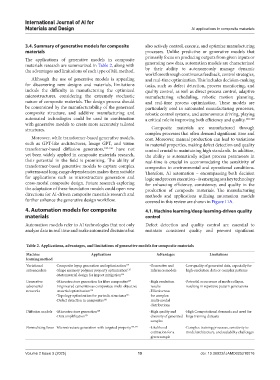
            The applications of generative models in composite   primarily focus on producing outputs from given inputs or
            materials research are summarized in Table 2, along with   generating new data, automation models are characterized
            the advantages and limitations of each type of ML method.  by their ability to autonomously manage dynamic
                                                               workflows through continuous feedback, control strategies,
              Although the use of generative models is appealing   and real-time optimization. This includes decision-making
            for discovering new designs and materials, limitations   tasks, such as defect detection, process monitoring, and
            include the difficulty in manufacturing the optimized   quality control, as well as direct process control, adaptive
            microstructures, considering the extremely stochastic   manufacturing scheduling, robotic motion planning,
            nature of composite materials. The design process should   and real-time process optimization. These models are
            be constrained by the manufacturability of the generated   particularly used in automated manufacturing processes,
            composite  structure,  and  additive  manufacturing  and   robotic control systems, and autonomous driving, playing
            automated technologies could be used in combination   a critical role in improving both efficiency and quality. 138-140
            with generative models to create more accurately tailored
            structures.                                          Composite materials are manufactured through
                                                               complex processes that often demand significant time and
              Moreover, while transformer-based generative models,   cost. Moreover, manual production can lead to variations
            such as GPT-like architectures, Image GPT, and vision   in material properties, making defect detection and quality
            transformer-based diffusion generators, 134-136  have not   control crucial to maintaining high standards. In addition,
            yet been widely applied in composite materials research,   the ability to automatically adjust process parameters in
            their  potential  in  the  field  is  promising.  The  ability  of   real-time is crucial in accommodating the sensitivity of
            transformer-based generative models to capture complex   composites to environmental and operational conditions.
            patterns and long-range dependencies makes them suitable   Therefore, AI automation – encompassing both decision
            for applications such as microstructure generation and   logic and process execution – is emerging as a key technology
            cross-modal composite design. Future research exploring   for enhancing efficiency, consistency, and quality in the
            the adaptation of these foundation models could open new   production of composite materials. The manufacturing
            directions for AI-driven composite materials research and   methods and applications utilizing automation models
            further enhance the generative design workflow.    covered in this review are shown in Figure 11A.

            4. Automation models for composite                 4.1. Machine learning/deep learning-driven quality
            materials                                          control

            Automation models refer to AI technologies that not only   Defect detection and quality control are essential to
            analyze data in real time and make automated decisions but   maintain  consistent  quality  and  prevent  significant


            Table 2. Applications, advantages, and limitations of generative models for composite materials

            Machine                     Applications                Advantages            Limitations
            learning method
            Variational   - Composite layup generation and optimization 117  - Generative and   - Low quality of generated data, especially for
            autoencoders  -Shape memory polymer property optimization 115  inference models  high-resolution data or complex patterns
                         -Metamaterial design for impact mitigation 116
            Generative   -Microstructure generation for fiber composites 123  - High resolution   - Potential occurrence of mode collapse,
            adversarial   - Engineered cementitious composites: multi-objective   results  resulting in repetitive pattern generations
            networks     material optimization 124               - Effectiveness
                         -Topology optimization for periodic structures 125  for complex
                         -Defect detection in composites 126     multi-modal
                                                                 distributions
            Diffusion models -Microstructure generation 128      - High quality and   - High Computational demands and need for
                         -Data amplification 131                 diversity of generated  large training datasets
                                                                 samples
            Normalizing flows Microstructure generation with targeted property 133,137  - Likelihood   - Complex training processes, sensitivity to
                         -
                                                                 estimation for a   model architecture, and scalability challenges
                                                                 given sample


            Volume 2 Issue 3 (2025)                         19                        doi: 10.36922/IJAMD025210016

