


Page 28 - IJAMD-2-3
P. 28
International Journal of AI for
            Materials and Design                                                   AI applications in composite materials


            in  defect  detection.  The  approach  demonstrates  a  good   temperature profile for CFRP curing, resulting in a 40%
            balance between real-time performance and accuracy,   reduction in curing time compared to traditional methods.
            optimizing the AFP part quality and enhancing the   Furthermore, the study employed Bayesian optimization
            overall process efficiency. In addition, the integration of   to adjust the mold thickness based on the geometry of the
            decision support systems in AFP would be beneficial, as   CFRP part, improving heat transfer and preventing local
            these systems assist in defect detection, segmentation, and   overheating. This approach demonstrates the potential of
            precision assessment, further streamlining the process.  reinforcement learning as autonomous AI optimizes both
              In  terms of  process  optimization, a  theory-guided   process time and energy consumption, thereby significantly
            probabilistic ML (TGML) approach has been proposed   enhancing the efficiency of the composite curing process.
            for minimizing process-induced deformations (PIDs) in   4.3. Summary of automation models for composite
            composite materials.  This method provides a reliable   materials
                             148
            prediction model for optimizing key process parameters,
            such as layup design and curing cycles, using minimal   These advancements highlight the growing role of AI in
            experimental data. By utilizing TGML, the study identified   automating and optimizing the composite manufacturing
            an optimal layup configuration and curing cycle, achieving   process. To date, only  a limited number of studies  have
            significant reductions in PIDs and production costs. The   applied autonomous AI in composite materials research.
            study demonstrates how ML can be applied to optimize   With  continuous  improvements  in  process  monitoring,
            complex manufacturing processes without the need for   modeling, and optimization, ML/DL-driven approaches
            extensive experimental trials.                     are paving the way for more efficient, reliable, and cost-
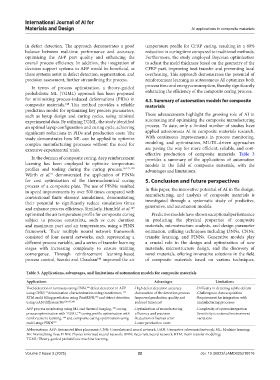
                                                               effective production of composite materials.  Table  3
              In the domain of composite curing, deep reinforcement   provides a summary of the applications of automation
            learning  has been employed to  optimize  temperature   models in the field of composite materials, with the
            profiles and tooling during the curing process. 76,127,130    advantages and limitations.
            Würth  et al.  demonstrated the application of PINNs
                      91
            for cost optimization of the thermochemical curing   5. Conclusion and future perspectives
            process of a composite plate. The use of PINNs resulted   In this paper, the innovative potential of AI in the design,
            in speed improvements by over 500 times compared with   manufacturing, and analysis of composite materials is
            conventional  finite element simulations, demonstrating
            their potential to significantly reduce simulation times   investigated through a systematic study of predictive,
            and enhance process efficiency. Similarly, Humfeld et al.    generative, and automation models.
                                                         149
            optimized the air temperature profile for composite curing   Predictive models have shown exceptional performance
            subject to process constraints, such as cure duration   in predicting the physical properties of composite
            and maximum part and air temperatures, using a PINN   materials, microstructure analysis, and design parameter
            framework. Their multiple neural network framework   estimation, utilizing techniques including DNNs, CNNs,
            consisted  of  four  neural  networks,  each  representing  a   transfer learning, and PINNs. Generative models play
            different process variable, and a series of transfer learning   a crucial role in the design and optimization of new
            stages with increasing complexity to ensure training   materials, microstructure design, and the discovery of
            convergence. Through reinforcement learning-based   novel materials, offering innovative solutions in the field
            process control, Szarski and Chauhan  improved the air   of composite materials based on various techniques,
                                          146

            Table 3. Applications, advantages, and limitations of automation models for composite materials
            Applications                                           Advantages                Limitations
            Void detection in laminates using CNN,  defect detection in AFP   - High defect detection accuracy  - Difficulty in detecting subtle defects
                                      143
            using CNN,  delamination characterization using transformer,     - Automation of the detection process  - Challenges in data acquisition
                    141
                                                     144
            RTM mold filling prediction using PixelRNN,  and defect detection  - Improved production quality and   - Requirement for integration with
                                          142
            using GAN/diffusion/NF 126,131,146            reduced time/cost          manufacturing processes
            AFP process monitoring using ML and thermal imaging,   curing   - Optimization of manufacturing   - Complexity of system integration
                                                 147
                                  148
            process optimization with TGML,  curing profile optimization with   efficiency and precision  - Sensitivity to external environment
            reinforcement learning,   and composite curing optimization using   - Reduction of human error  variations
                            146
            multi-stage PINN 149                          - Lower production costs
            Abbreviations: AFP: Automated fiber placement; CNN: Convolutional neural network; GAN: Generative adversarial network; ML: Machine learning;
            NF: Normalizing flow; PINN: Physics-informed neural network; RNN: Recurrent neural network; RTM: Resin transfer modeling;
            TGML: Theory-guided probabilistic machine learning.
            Volume 2 Issue 3 (2025)                         22                        doi: 10.36922/IJAMD025210016

