


Page 8 - IJAMD-2-3
P. 8
International Journal of AI for
            Materials and Design                                                   AI applications in composite materials


            lightweight characteristics and outstanding mechanical   microstructure design, novel material discovery, and
            performance of composite materials make them essential   data augmentation 22
            in various industries, including aerospace, automotive,   (iii) Automation: ML is applied to optimize composite
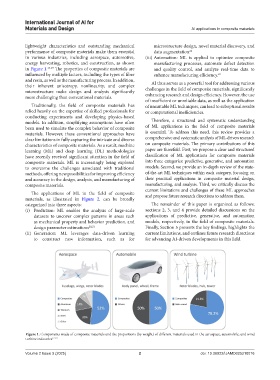
            energy harvesting, robotics, and construction, as shown   manufacturing processes, automate  defect detection
            in Figure 1. 13-19  The properties of composite materials are   and quality control, and analyze real-time data to
            influenced by multiple factors, including the types of fiber   enhance manufacturing efficiency. 23
            and resin, as well as the manufacturing process. In addition,   AI thus serves as a powerful tool for addressing various
            their  inherent  anisotropy,  nonlinearity,  and  complex   challenges in the field of composite materials, significantly
            microstructure make design and analysis significantly
            more challenging than conventional materials.      enhancing research and design efficiency. However, the use
                                                               of insufficient or unreliable data, as well as the application
              Traditionally, the  field  of composite  materials  has   of unsuitable ML techniques, can lead to suboptimal results
            relied heavily on the expertise of skilled professionals for   or computational inefficiencies.
            conducting experiments and developing physics-based
            models. In addition, simplifying assumptions have often   Therefore, a structured and systematic understanding
            been used to simulate the complex behavior of composite   of ML applications in the field of composite materials
            materials. However, these conventional approaches have   is essential. To address this need, this review provides a
            clear limitations in fully capturing the intricate and diverse   comprehensive and systematic analysis of ML-driven research
            characteristics of composite materials. As a result, machine   on composite materials. The primary contributions of this
            learning (ML) and deep learning (DL) methodologies   paper are threefold. First, we propose a clear and structured
            have recently received significant attention in the field of   classification of ML applications for composite materials
            composite materials. ML is increasingly being explored   into three categories: predictive, generative, and automation
            to overcome the challenges associated with traditional   models. Second, we provide an in-depth review of the state-
            methods, offering new possibilities for improving efficiency   of-the-art ML techniques within each category, focusing on
            and accuracy in the design, analysis, and manufacturing of   their practical applications in composite material design,
            composite materials.                               manufacturing, and analysis. Third, we critically discuss the
                                                               current limitations and challenges of these ML approaches
              The applications of ML in the field of composite
            materials, as illustrated in  Figure  2, can be broadly   and propose future research directions to address them.
            categorized into three aspects:                      The remainder of this paper is organized as follows:
            (i)  Prediction: ML  enables  the analysis  of  large-scale   sections 2, 3, and 4 provide detailed discussions on the
               datasets to uncover complex patterns in areas such   applications of predictive, generative, and automation
               as mechanical property and behavior prediction, and   models, respectively, in the field of composite materials.
               design parameter estimations 20,21              Finally, Section 5 presents the key findings, highlights the
            (ii)  Generation: ML leverages data-driven learning   current limitations, and outlines future research directions
               to construct new information, such as for       for advancing AI-driven developments in this field.


            Figure 1. Components made of composite materials and the proportions (by weight) of different materials used in the aerospace, automobile, and wind
            turbine industries 17-19


            Volume 2 Issue 3 (2025)                         2                         doi: 10.36922/IJAMD025210016

