


Page 12 - IJAMD-2-3
P. 12
International Journal of AI for
            Materials and Design                                                   AI applications in composite materials


                         A


                          B                            C


                          D


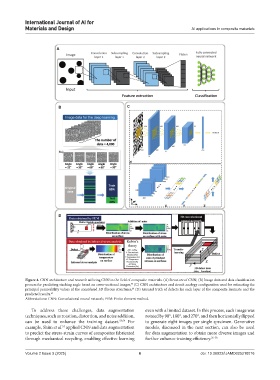
            Figure 4. CNN architecture and research utilizing CNN in the field of composite materials. (A) Structure of CNN; (B) Image data and data classification
            process for predicting stacking angle based on cross-sectional images;  (C) CNN architecture and circuit analogy configuration used for estimating the
                                                         45
            principal permeability values of the considered 3D fibrous structures;  (D) Ground truth of defects for each layer of the composite laminate and the
                                                         46
            predicted results. 47
            Abbreviations: CNN: Convolutional neural network; FEM: Finite element method.
              To address these challenges, data augmentation   even with a limited dataset. In this process, each image was
            techniques, such as rotation, distortion, and noise addition,   rotated by 90°, 180°, and 270°, and then horizontally flipped
            can be used to enhance the training dataset. 53,54  For   to generate eight images per single specimen. Generative
            example, Shim et al.  applied CNN and data augmentation   models, discussed in the next section, can also be used
                            55
            to predict the stress-strain curves of composites fabricated   for data augmentation to obtain more diverse images and
            through mechanical recycling, enabling effective learning   further enhance training efficiency. 56-58


            Volume 2 Issue 3 (2025)                         6                         doi: 10.36922/IJAMD025210016

