


Page 16 - IJAMD-2-3
P. 16
International Journal of AI for
            Materials and Design                                                   AI applications in composite materials


             A


              B                                            C


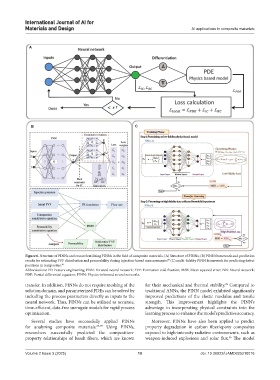
            Figure 6. Structure of PINNs and research utilizing PINNs in the field of composite materials. (A) Structure of PINNs; (B) PINN framework and prediction
            results for estimating FVF distribution and permeability during injection-based measurements;  (C) multi-fidelity PINN framework for predicting defect
                                                                        89
            positions in composites. 90
            Abbreviations: FE: Feature engineering; FNN: Forward neural network; FVF: Formation void fraction; MSE: Mean squared error; NN: Neural network;
            PDE: Partial differential equation; PINN: Physics-informed neural networks.

            transfer. In addition, PINNs do not require meshing of the   for their mechanical and thermal stability.  Compared to
                                                                                                 92
            solution domain, and parameterized PDEs can be solved by   traditional ANNs, the PINN model exhibited significantly
            including the process parameters directly as inputs to the   improved predictions of the elastic modulus and tensile
            neural network. Thus, PINNs can be utilized as accurate,   strength. This improvement highlights the PINN’s
            time-efficient, data-free surrogate models for rapid process   advantage in incorporating physical constraints into the
            optimization.                                      learning process to enhance the model’s predictive accuracy.
              Several studies have successfully applied PINNs    Moreover, PINNs have also been applied to predict
            for analyzing composite materials. 89-95  Using PINNs,   property degradation in carbon fiber/epoxy composites
            researchers successfully predicted the composition-  exposed to high-intensity radiative environments, such as
            property relationships of basalt fibers, which are known   weapon-induced explosions and solar flux.  The model
                                                                                                  95

            Volume 2 Issue 3 (2025)                         10                        doi: 10.36922/IJAMD025210016

