


Page 541 - IJB-10-3
P. 541
International Journal of Bioprinting                               Engineered 3D-printed PVA vascular grafts


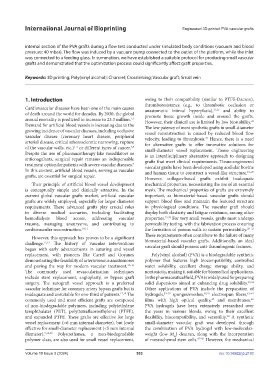
            internal section of the PVA grafts during a flow test conducted under simulated body conditions (vacuum and blood
            pressure: 40 mbar). The flow was induced by a vacuum pump connected to the outlet of the platform, while the inlet
            was connected to a feeding glass. In summation, we have established a suitable protocol for producing small vascular
            grafts and demonstrated that the optimization process could significantly affect graft properties.


            Keywords: 3D printing; Poly(vinyl alcohol); Channel; Crosslinking; Vascular graft; Small vein


            1. Introduction                                    owing to their compatibility (similar to PTFE-Dacron),
                                                               thromboresistance (e.g., to thrombotic occlusion or
            Cardiovascular diseases have been one of the main causes   anastomotic intimal hyperplasia), 21,22  and ability to
            of death around the world for decades. By 2030, the global   promote  tissue  growth  inside  and  around  the  grafts.
            annual mortality is predicted to increase to 23.3 million.    However, their clinical use is limited by low biostability.
                                                         1,2
                                                                                                            22
            Demand for artificial blood vessels is increasing due to the   The low patency of most synthetic grafts in small-diameter
            growing incidence of vascular diseases, including occlusive   vessel reconstruction is caused by reduced blood flow
            vascular disease (coronary heart disease, peripheral   velocity, leading to thrombosis.  Hence, there is a need
                                                                                         23
            arterial disease, critical atherosclerotic narrowing, rupture   for alternative grafts to offer innovative solutions for
            of the vascular walls, etc.)  or different types of cancer.    small-diameter vessel replacement. Tissue  engineering
                                 3–6
                                                         7,8
            Despite the use of pharmacotherapy like vasodilators or   is an interdisciplinary alternative approach to designing
            anticoagulants, surgical repair remains an indispensable   grafts that meet clinical requirements. Tissue-engineered
            treatment option for patients with severe vascular diseases.    vascular grafts have been developed using acellular bovine
                                                          9
            In this context, artificial blood vessels, serving as vascular   and human tissue to construct a vessel-like structure. 24–26
            grafts, are essential for surgical repair.
                                                               However, collagen-based grafts exhibit inadequate
               Their principle of artificial blood vessel development   mechanical properties, necessitating the use of an external
            is conceptually simple and clinically attractive. In the   mesh. The mechanical properties of grafts are extremely
            current global vascular grafts market, artificial vascular   important, as biomaterial-based vascular grafts should
            grafts are widely employed, especially for larger diameter   support  blood  flow  and  maintain  the  featured  structure
            requirements. These advanced grafts play crucial roles   in physiological conditions. The vascular graft should
            in diverse medical scenarios, including facilitating   display both elasticity and fatigue resistance, among other
            hemodialysis  blood  access,  addressing  vascular  properties. 27,28  For very small vessels, grafts must undergo
            trauma, managing aneurysms, and contributing to    permeability testing, with the fabrication process ensuring
            cardiovascular reconstruction. 10,11               the formation of porous walls to sustain permeability. 29–32
                                                               These requirements often contribute to the failure of many
               However, this approach has proven to be a significant
            challenge. 12,13  The history of vascular interventions   biomaterial-based vascular grafts. Additionally, an ideal
                                                               vascular graft should possess anti-thrombogenic features.
            began with early advancements in  suturing and vessel
            replacement, with pioneers like Carrel and Goyanes    Poly(vinyl alcohol) (PVA) is a biodegradable synthetic
            demonstrating the feasibility of arteriovenous anastomoses   polymer that features high biocompatibility, controlled
            and paving the way for modern vascular treatment. 14–16    water solubility, excellent charge storage ability, and
            The commonly used revascularization techniques     nontoxicity, making it suitable for biomedical applications.
            include stent replacement, angioplasty, or bypass graft   In the pharmaceutical field, PVA is widely used for preparing
            surgery. The autograft vessel approach is a preferred   solid  dispersions  aimed  at  enhancing  drug  solubility. 33,34
            vascular technique for coronary artery bypass grafts but is   Other applications of PVA include the preparation of
            inadequate and unsuitable for one-third of patients. 17,18  The   hydrogels, 35–39  sponges/meshes, 40,41  electrospun fibers, 42–44
            commonly  used  and  most  efficient  grafts  are  composed   films with high optical quality,  and membranes.
                                                                                                            46
                                                                                           45
            of non-biodegradable polymers, including poly(ethylene   PVA hydrogels have been extensively researched over
            terephthalate) (PET), poly(tetrafluoroethylene) (PTFE),   the years in various blends, owing to their excellent
            and expanded PTFE. These grafts are effective for large   flexibility, biocompatibility, and versatility.  A synthetic
                                                                                                  38
            vessel replacement (>6 mm internal diameter), but lowly   small-diameter  vascular  graft  was  developed  through
            effective for small-diameter replacement (<5 mm internal   the combination of PVA hydrogel with low-molecular-
            diameter). 5,19,20  Polyurethanes, a non-biodegradable   weight (low  M ) dextran, along with the incorporation
                                                                           w
            polymer class, are also used for small vessel replacement,   of mesenchymal stem cells. 47–50  However, the mechanical

            Volume 10 Issue 3 (2024)                       533                                doi: 10.36922/ijb.2193

