


Page 285 - IJB-10-4
P. 285
International Journal of Bioprinting                                  3D printing prosthesis for palatal fistula


            Elastomer  in the compression test (p < 0.01). The tensile   models and the finished printed products (Figure 2B).
                    2
            moduli of both elastomers (Figure 7F) are not statistically   Finally, the prosthesis was implanted into the animal
            different (p > 0.05). Subsequently, in the compression   model’s palate defect, and the prosthesis was appropriately
            test, the compressive strength (Figure 7G) and Young’s   positioned. The fistula was repaired accurately (Figure S1 in
            modulus (Figure 7H) of Elastomer  were higher than   Supplementary File). The prosthesis is shown in Figure S2
                                          4
            those of Elastomer  (p < 0.01). Thus, we consider that the   (Supplementary File).
                           2
            mechanical properties of Elastomer  are more potent than
                                        4
            those of Elastomer .                               3.7. Biocompatibility tests of PU elastomers
                           2
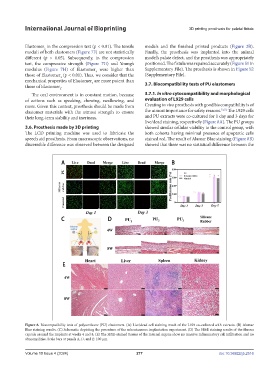
               The oral environment is in constant motion, because   3.7.1. In vitro cytocompatibility and morphological
            of actions such as speaking, chewing, swallowing, and   evaluation of L929 cells
            more. Given this context, prosthesis should be made from   Creating in vivo prosthesis with good biocompatibility is of
            elastomer materials with the utmost strength to ensure   the utmost importance for safety reasons. 51,52  The L929 cells
            their long-term stability and inertness.           and PU extracts were co-cultured for 1 day and 3 days for
                                                               live/dead staining, respectively (Figure 8A). The PU groups
            3.6. Prosthesis made by 3D printing                showed similar cellular viability to the control group, with
            The LCD printing machine was used to fabricate the   both cohorts having minimal presence of apoptotic cells
            speech aid prosthesis. From macroscopic observations, no   stained red. The result of Alamar Blue staining (Figure 8B)
            discernible difference was observed between the designed   showed that there was no statistical difference between the


            Figure 8. Biocompatibility tests of polyurethane (PU) elastomers. (A) Live/dead cell staining result of the L929 co-cultured with extracts. (B) Alamar
            Blue staining results. (C) Schematic depicting the procedure of the subcutaneous implantation experiment. (D) The H&E staining results of the fibrous
            capsule around the implants at weeks 4 and 8. (E) The H&E-stained tissues of the internal organs show no massive inflammatory cell infiltration and no
            abnormalities. Scale bars at panels A, D, and E: 100 µm.


            Volume 10 Issue 4 (2024)                       277                                doi: 10.36922/ijb.2516

