


Page 79 - IJB-10-4
P. 79
International Journal of Bioprinting                          Unique characteristics of 3D-printed microneedles


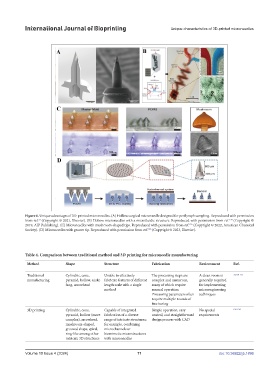
            Figure 6. Unique advantages of 3D-printed microneedles. (A) Hollow surgical microneedle designed for perilymph sampling. Reproduced with permission
            from ref.  (Copyright © 2021, Elsevier). (B) Hollow microneedles with a microfluidic structure. Reproduced with permission from ref.  (Copyright ©
                                                                                                   124
                 53
            2019, AIP Publishing). (C) Microneedles with mushroom-shaped tips. Reproduced with permission from ref.  (Copyright © 2022, American Chemical
                                                                                  125
            Society). (D) Microneedles with groove tip. Reproduced with permission from ref.  (Copyright © 2023, Elsevier).
                                                                126

            Table 4. Comparison between traditional method and 3D printing for microneedle manufacturing
             Method          Shape            Structure           Fabrication         Environment    Ref.

             Traditional     Cylindric, cone,   Unable to effectively   The processing steps are   A clean room is   33,150-155
             manufacturing   pyramid, hollow, snake  fabricate features of different   complex and numerous,   generally required
                             fang, arrowhead  length scale with a single   many of which require   for implementing
                                              method              manual operation;   microengineering
                                                                  Processing parameters often   techniques
                                                                  require multiple rounds of
                                                                  fine tuning
             3D printing     Cylindric, cone,   Capable of integrated   Simple operation, easy   No special   156-159
                             pyramid, hollow (more  fabrication of a diverse   control, and straightforward   requirements
                             complex), arrowhead,   range of intricate structures;   design process with CAD
                             mushroom-shaped,   for example, combining
                             grooved shape, spiral,   microchannels or
                             ring-like among other   biomimetic microstructures
                             intricate 3D structures  with microneedles


            Volume 10 Issue 4 (2024)                        71                                doi: 10.36922/ijb.1896

