


Page 89 - IJB-6-3
P. 89
Yusupov, et al.
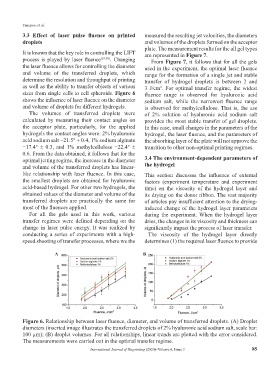
           3.3  Effect  of  laser  pulse  fluence  on  printed   measured the resulting jet velocities, the diameters
           droplets                                            and volumes of the droplets formed on the acceptor
                                                               plate. The measurement results for the all gel types
           It is known that the key role in controlling the LIFT   are represented in Figure 7.
           process  is  played  by  laser  fluence [19,30] .  Changing   From Figure 7, it follows that for all the gels
           the laser fluence allows for controlling the diameter   used in the experiment, the optimal laser fluence
           and  volume  of  the  transferred  droplets,  which   range for the formation of a single jet and stable
           determine the resolution and throughput of printing   transfer  of  hydrogel  droplets  is  between  2  and
           as well as the ability to transfer objects of various   3 J/cm . For optimal transfer regime, the widest
                                                                     2
           sizes from single cells to cell spheroids. Figure 6   fluence  range  is  observed  for  hyaluronic  acid
           shows the influence of laser fluence on the diameter   sodium  salt,  while  the  narrowest  fluence  range
           and volume of droplets for different hydrogels.     is observed for methylcellulose. That is, the use
             The  volumes  of  transferred  droplets  were     of  2%  solution  of  hyaluronic  acid  sodium  salt
           calculated  by  measuring  their  contact  angles  on   provides the most stable transfer of gel droplets.
           the  acceptor  plate,  particularly,  for  the  applied   In this case, small changes in the parameters of the
           hydrogels the contact angles were: 2% hyaluronic    hydrogel, the laser fluence, and the parameters of
           acid sodium salt −21.5° ± 0.4, 1% sodium alginate   the absorbing layer of the plate will not approve the
           −17.4°  ±  0.3,  and  1%  methylcellulose  −22.4°  ±   transition to other non-optimal printing regimes.
           0.6. From the data obtained, it follows that for the
           optimal jetting regime, the increase in the diameter   3.4 The environment-dependent parameters of
           and volume of the transferred droplets has linear-  the hydrogel
           like relationship with laser fluence. In this case,   This  section  discusses  the  influence  of  external
           the smallest droplets are obtained for hyaluronic   factors  (experiment  temperature  and  experiment
           acid-based hydrogel. For other two hydrogels, the   time)  on  the  viscosity  of  the  hydrogel  layer  and
           obtained values of the diameter and volume of the   its drying on the donor ribbon. The vast majority
           transferred  droplets  are  practically  the  same  for   of articles pay insufficient attention to the drying-
           most of the fluences applied.                       induced change of the hydrogel layer parameters
             For  all  the  gels  used  in  this  work,  various   during  the  experiment. When  the  hydrogel  layer
           transfer  regimes  were  defined  depending  on  the   dries, the changes in its viscosity and thickness can
           change in laser pulse energy. It was realized by    significantly impact the process of laser transfer.
           conducting a series of experiments with a high-       The  viscosity  of  the  hydrogel  layer  directly
           speed shooting of transfer processes, where we the   determines (1) the required laser fluence to provide


                        A                                     B


           Figure 6. Relationship between laser fluence, diameter, and volume of transferred droplets. (A) Droplet
           diameters (inserted image illustrates the transferred droplets of 2% hyaluronic acid sodium salt, scale bar:
           100 µm); (B) droplet volumes. For all relationships, linear trends are plotted with the error considered.
           The measurements were carried out in the optimal transfer regime.
                                       International Journal of Bioprinting (2020)–Volume 6, Issue 3        85

