


Page 16 - IJB-10-6
P. 16
International Journal of Bioprinting                                3D-bioprinted multicellular lung organoids


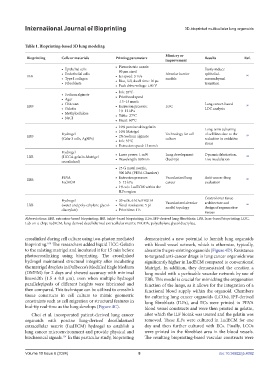
            Table 1. Bioprinting-based 3D lung modeling
                                                                        Mimicry or
             Bioprinting   Cells or materials     Printing parameters                   Results          Ref.
                                                                        improvement
                                                  •  Piezoelectric nozzle:
                           •   Epithelial cells     80 µm sized                         Easily induce
                           •   Endothelial cells                        Alveolar barrier   epithelial-
             IBB                                  •  Jet speed: 3 m/s                                     86
                           •  Type I collagen     •  Rise, fall, dwell time: 10 µs  models  mesenchymal
                           •   Fibroblasts                                              transition
                                                  •  Peak drive voltage: ±80 V
                                                  •   Ink: 28°C
                           •   Sodium alginate    •  Printhead speed
                           •   Agar                 :13–15 mm/s
                           •   Chitosan                                                 Lung cancer-based
             EBB                                  •  Extrusion pressure:    LOC                           98
                           •   Gelatin              10–12 kPa                           LOC analysis
                           •   Methylcellulose    •  Table: 27°C
                           •   NaCl
                                                  •  Head: 60°C
                                                  •   10% porcine skin gelatin          Long-term culturing
                                                  •   10% Matrigel
                           Hydrogel                                     Technology for cell   of cell lines due to the
             EBB                                  •   2% Sodium alginate                                  99
                           (Calu-3 cells, AgNPs)                        culture         reduction in oxidative
                                                  •   Ink: 35°C                         stress
                                                  •  Extrusion speed: 13 mm/s
                           Hydrogel
             LBB           (HCCA-gelatin-Matrigel   •  Laser power: 1 mW  Lung development  Dynamic fabrication,   100
                                                                        (bud tip)
                                                  •   Wavelength: 800 nm
                                                                                        Live modulation
                           crosslinked)
                                                  •  25 G metal nozzle,
                                                    500 kPA (PEVA Chamber)
                           PEVA                   •  Extrusion pressure:    Vascularized lung   Anti-cancer drug
             EBB                                                                                          101
                           LudECM                   5–12 kPa            cancer          evaluation
                                                  •  1% w/v LudECM within the
                                                    ILFs region
                                                                                        Control over tissue
                           Hydrogel               •  20 wt%, 6 kDa PEGDA
             LBB           (water and poly-ethylene glycol-   •  Voxel resolution: 5 pl  Vascularized alveolar   architecture and   105
                                                                                        design of regenerative
                                                                        model topology
                           diacrylate)            •  Print time: 1 h
                                                                                        tissues
            Abbreviations: EBB, extrusion-based bioprinting; IBB, inkjet-based bioprinting; ILFs, IPF-derived lung fibroblasts; LBB, laser-based bioprinting; LOC,
            Lab-on-a-chip; LudECM, lung-derived decellularized extracellular matrix; PEGDA, polyethylene glycol diacrylate.
            crosslinked during cell culture using two-photon mediated   demonstrated a new potential to furnish lung organoids
                     100
            bioprinting.  The researchers added liquid HCC-Gelatin   with blood vessel network, which is otherwise, typically,
            to the existing matrigel and incubated it for 15 min before   absent in the pre-existing organoids (Figure 4D). Resistance
            photocrosslinking using bioprinting. The crosslinked   to targeted anti-cancer drugs in lung cancer organoids was
            hydrogel maintained structural integrity after incubating   significantly higher in LudECM compared to conventional
            the matrigel droplets in Dulbecco‘s Modified Eagle Medium   Matrigel. In addition, they demonstrated the creation a
            (DMEM) for 2 days and showed accuracy with minimal   lung model with a perfusable vascular network by use of
            linewidth (1.5 ± 0.8 µm), even when multiple hydrogel   EBB. This model is crucial for mimicking the oxygenation
            parallelepipeds of different heights were fabricated and   function of the lungs, as it allows for the integration of a
            then compared. This technique can be utilized to crosslink   functional blood supply  within the  organoid.  Chambers
            tissue constructs in cell culture to mimic geometric   for culturing lung cancer organoids (LCOs), IPF-derived
            constraints such as cell migration or structural features in   lung fibroblasts (ILFs), and ECs were printed in PEVA
            bud-tip real-time as the lung develops (Figure 4C).  blood vessel constructs and were then printed in gelatin,
              Choi et al. incorporated patient-derived lung cancer   after which the ILF bioink was treated and the gelatin was
            organoids  with porcine lung-derived decellularized   removed. These ILFs were cultured in LudECM for one
            extracellular matrix (LudECM) hydrogel to establish a   day and then further cultured with ECs. Finally, LCOs
            lung cancer microenvironment and provide physical and   were printed in the fibroblast area in the blood vessels.
            biochemical signals.  In this particular study, bioprinting   The resulting bioprinting-based vascular constructs were
                            101

            Volume 10 Issue 6 (2024)                        8                                 doi: 10.36922/ijb.4092

