


Page 51 - IJB-9-2
P. 51
International Journal of Bioprinting                             Biocompatible materials and Multi Jet Fusion


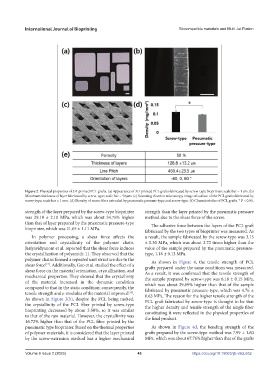
            Figure 2. Physical properties of 3D-printed PCL grafts. (a) Appearance of 3D-printed PCL grafts fabricated by screw-type bioprinter; scale bar = 1 cm. (b)
            Minimum thickness of layer fabricated by screw-type; scale bar = 50 µm. (c) Scanning electron microscopy image of surface of the PCL grafts fabricated by
            screw-type; scale bar = 1 mm. (d) Density of mono fiber extruded by pneumatic pressure-type and screw-type. (f) Characteristics of PCL grafts. * P < 0.05.
            strength of the layer prepared by the screw-type bioprinter   strength than the layer printed by the pneumatic pressure
            was 29.18 ± 2.10 MPa, which was about 34.76% higher   method due to the shear force of the screw.
            than that of layer prepared by the pneumatic pressure-type   The adhesive force between the layers of the PCL graft
            bioprinter, which was 21.65 ± 1.11 MPa.
                                                               fabricated by the two types of bioprinter was measured. As
               In  polymer  processing,  a  shear  force  affects  the   a result, the sample fabricated by the screw-type was 3.15
            orientation and  crystallinity of  the polymer  chain.   ± 0.30 MPa, which was about 2.72 times higher than the
            Jariyavidyanont et al. reported that the shear force induces   value of the sample prepared by the pneumatic pressure-
            the crystallization of polyamide 11. They observed that the   type, 1.16 ± 0.13 MPa.
            polymer chains formed a repeated unit structure due to the   As shown in  Figure 4, the tensile strength of PCL
            shear force . Additionally, Gao et al. studied the effect of a   grafts prepared under the same conditions was measured.
                    [17]
            shear force on the material orientation, crystallization, and   As a result, it was confirmed that the tensile strength of
            mechanical properties. They showed that the crystallinity   the sample prepared by screw-type was 6.18 ± 0.15 MPa,
            of the material increased in the dynamic condition   which was about 29.89% higher than that of the sample
            compared to that in the static condition; consequently, the   fabricated by pneumatic pressure-type, which was 4.76 ±
            tensile strength and e-modulus of the material improved .   0.63 MPa. The reason for the higher tensile strength of the
                                                        [18]
            As shown in Figure 3(b), despite the PCL being melted,   PCL graft fabricated by screw-type is thought to be that
            the crystallinity of the PCL fiber printed by screw-type   the higher density and tensile strength of the single fiber
            bioprinting decreased by about 3.50%, so it was similar   constituting it were reflected in the physical properties of
            to that of the raw material. However, the crystallinity was   the final product.
            16.72% higher than that of the PCL fiber printed by the
            pneumatic type bioprinter. Based on the thermal properties   As shown in  Figure 4d, the bending strength of  the
            of polymer materials, it is considered that the layer printed   grafts prepared by the screw-type method was 7.99 ± 1.60
            by the screw-extrusion method has a higher mechanical   MPa, which was about 67.76% higher than that of the grafts


            Volume 9 Issue 2 (2023)                         43                     https://doi.org/10.18063/ijb.v9i2.652

