


Page 356 - IJB-9-6
P. 356
International Journal of Bioprinting                                   Surface modification of PCL scaffolds


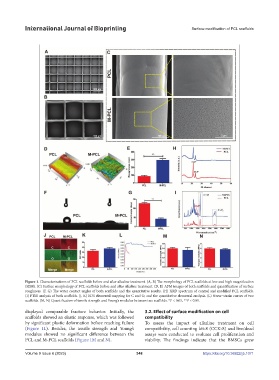
            Figure 1. Characterizations of PCL scaffolds before and after alkaline treatment. (A, B) The morphology of PCL scaffolds at low and high magnification
            (SEM). (C) Surface morphology of PCL scaffolds before and after alkaline treatment. (D, E) AFM images of both scaffolds and quantification of surface
            roughness. (F, G) The water contact angles of both scaffolds and the quantitative results. (H) XRD spectrum of control and modified PCL scaffolds.
            (I) FTIR analysis of both scaffolds. (J, K) EDS elemental mapping for C and O, and the quantitative elemental analysis. (L) Stress−strain curves of two
            scaffolds. (M, N) Quantification of tensile strength and Young’s modulus between two scaffolds. *P < 0.05, **P < 0.01.

            displayed comparable fracture behavior. Initially, the   3.2. Effect of surface modification on cell
            scaffolds showed an elastic response, which was followed   compatibility
            by significant plastic deformation before reaching failure   To assess the impact of alkaline treatment on cell
            (Figure 1L). Besides, the tensile strength and Young’s   compatibility, cell counting kit-8 (CCK-8) and live/dead
            modulus showed no significant difference between the   assays were conducted to evaluate cell proliferation and
            PCL and M-PCL scaffolds (Figure 1M and N).         viability. The findings indicate that the BMSCs grew


            Volume 9 Issue 6 (2023)                        348                          https://doi.org/10.36922/ijb.1071

