


Page 357 - IJB-9-6
P. 357
International Journal of Bioprinting                                   Surface modification of PCL scaffolds


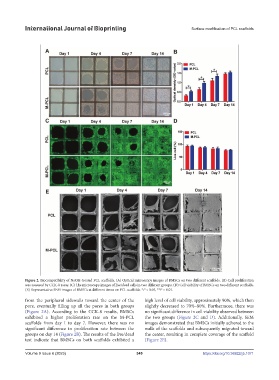
            Figure 2. Biocompatibility of NaOH-treated PCL scaffolds. (A) Optical microscopy images of BMSCs on two different scaffolds. (B) Cell proliferation
            was assessed by CCK-8 assay. (C) The microscopy images of live/dead cells in two different groups. (D) Cell viability of BMSCs on two different scaffolds.
            (E) Representative SEM images of BMSCs at different times on PCL scaffolds. *P < 0.05, **P < 0.01.

            from the peripheral sidewalls toward the center of the   high level of cell viability, approximately 90%, which then
            pore,  eventually  filling  up  all  the  pores  in  both  groups   slightly decreased to 70%–80%. Furthermore, there was
            (Figure  2A). According to the CCK-8 results, BMSCs   no significant difference in cell viability observed between
            exhibited  a  higher  proliferation  rate  on  the  M-PCL   the two groups (Figure 2C and  D). Additionally, SEM
            scaffolds from day 1 to day 7. However, there was no   images demonstrated that BMSCs initially adhered to the
            significant difference in proliferation rate between the   walls of the scaffolds and subsequently migrated toward
            groups on day 14 (Figure 2B). The results of the live/dead   the center, resulting in complete coverage of the scaffold
            test indicate that BMSCs on both scaffolds exhibited a   (Figure 2E).

            Volume 9 Issue 6 (2023)                        349                          https://doi.org/10.36922/ijb.1071

