


Page 353 - IJB-9-6
P. 353
International Journal of Bioprinting                                   Surface modification of PCL scaffolds


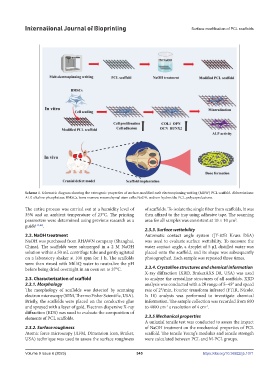
            Scheme 1. Schematic diagram showing the osteogenic properties of surface-modified melt electrospinning writing (MEW) PCL scaffold. Abbreviations:
            ALP, alkaline phosphatase; BMSCs, bone marrow mesenchymal stem cells; NaOH, sodium hydroxide; PCL, polycaprolactone.

            The entire process was carried out at a humidity level of   of scaffolds. To isolate the single fiber from scaffolds, it was
            35% and an ambient temperature of 23°C. The printing   then affixed to the tray using adhesive tape. The scanning
                                                                                                     2
            parameters were determined using previous research as a   area for all samples was consistent at 10 × 10 µm .
            guide [13,42] .
                                                               2.3.3. Surface wettability
            2.2. NaOH treatment                                Automatic contact angle system (JY-82B Kruss DSA)
            NaOH was purchased from RHAWN company (Shanghai,   was used to evaluate surface wettability. To measure the
            China). The scaffolds were submerged in a 2 M NaOH   water contact angle, a droplet of 5 μL distilled water was
            solution within a 50 mL centrifuge tube and gently agitated   placed onto the scaffold, and its shape was subsequently
            on a laboratory shaker at 100 rpm for 1 h. The scaffolds   photographed. Each sample was repeated three times.
            were then rinsed with MilliQ water to neutralize the pH
            before being dried overnight in an oven set to 37°C.  2.3.4. Crystalline structures and chemical information
                                                               X-ray diffraction (XRD, BrukerAXS D8, USA) was used
            2.3. Characterization of scaffold                  to analyze the crystalline structures of all scaffolds. XRD
            2.3.1. Morphology                                  analysis was conducted with a 2θ range of 5–45° and speed
            The morphology of scaffolds was detected by scanning   rate of 2°/min. Fourier transform infrared (FTIR, Nicolet
            electron microscopy (SEM, Thermo Fisher Scientific, USA).   Is  10)  analysis  was  performed  to  investigate  chemical
            Briefly, the scaffolds were placed on the conductive glue   information. The sample collection was recorded from 600
                                                                                         -1
                                                                        -1
            and sprayed with a layer of gold. Electron dispersive X-ray   to 4000 cm  a resolution of 4 cm .
            diffraction (EDS) was used to evaluate the composition of
            elements of PCL scaffolds.                         2.3.5 Mechanical properties
                                                               A uniaxial tensile test was conducted to assess the impact
            2.3.2. Surface roughness                           of NaOH treatment on the mechanical properties of PCL
            Atomic force microscopy (AFM, Dimension Icon, Bruker,   scaffold. The tensile Young’s modulus and tensile strength
            USA) technique was used to assess the surface roughness   were calculated between PCL and M-PCL groups.


            Volume 9 Issue 6 (2023)                        345                          https://doi.org/10.36922/ijb.1071

