


Page 194 - IJOCTA-15-1
P. 194
H.H. Yildirim, A. Akusta / IJOCTA, Vol.15, No.1, pp.183-201 (2025)
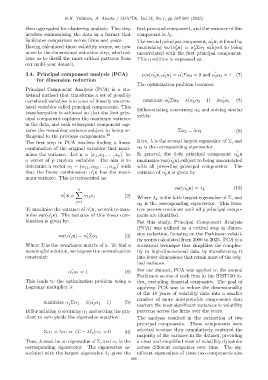
            then aggregated for clustering analysis. This step  first principal component, and the variance of this
            involves summarising the data in a format that    component is λ 1 .
                                                                                               ′
            facilitates comparison across firms and years.    The second principal component, α x, is found by
                                                                                               2
                                                                                       ′
                                                                               ′
            Having calculated these volatility scores, we now  maximizing var(α x) = α Σα 2 subject to being
                                                                               2       2
            move to the dimensional reduction step, which al-  uncorrelated with the first principal component.
            lows us to distill the most critical patterns from  This condition is expressed as:
            our multi-year dataset.
                                                                     ′    ′       ′              ′
            3.4. Principal component analysis (PCA)             cov(α x, α x) = α Σα 2 = 0 and α α 2 = 1 (7)
                                                                     1
                                                                          2
                                                                                                 2
                                                                                  1
                 for dimension reduction
                                                              The optimization problem becomes:
            Principal Component Analysis (PCA) is a sta-
            tistical method that transforms a set of possibly
                                                                            ′          ′            ′
            correlated variables into a set of linearly uncorre-  maximize α Σα 2 − λ(α α 2 − 1) − ϕα α 1  (8)
                                                                                       2
                                                                                                    2
                                                                            2
            lated variables called principal components. This
                                                              Differentiating concerning α 2 and solving similar
            transformation is achieved so that the first prin-
                                                              yields:
            cipal component captures the maximum variance
            in the data, and each subsequent component cap-
            tures the remaining variance subject to being or-                   Σα 2 = λα 2               (9)
            thogonal to the previous components. 48
            The first step in PCA involves finding a linear   Here, λ is the second largest eigenvalue of Σ, and
            combination of the original variables that maxi-  α 2 is the corresponding eigenvector.
                                                       ′                                                  ′
            mizes the variance. Let x = (x 1 , x 2 , . . . , x p ) be  In general, the k-th principal component α x
                                                                                                          k
                                                                              ′
            a vector of p random variables. The aim is to     maximizes var(α x) subject to being uncorrelated
                                                      ′                       k
            determine a vector α 1 = (α 11 , α 12 , . . . , α 1p ) such  with all preceding principal components.  The
                                                                          ′
                                          ′
            that the linear combination α x has the maxi-     variance of α x is given by:
                                          1                               k
            mum variance. This is represented as:
                                                                                    ′
                                    p                                          var(α x) = λ k            (10)
                                                                                    k
                                   X
                             ′
                            α x =     α 1j x j          (2)   Where λ k is the k-th largest eigenvalue of Σ, and
                             1
                                   j=1
                                                              α k is the corresponding eigenvector. This itera-
                                         ′
            To maximize the variance of α x, we seek to max-  tive process continues until all p principal compo-
                                         1
                       ′
            imize var(α x). The variance of this linear com-  nents are identified.
                       1
            bination is given by:                             For this study, Principal Component Analysis
                                                              (PCA) was utilized as a critical step in dimen-
                                ′       ′                     sion reduction, focusing on the Parkinson volatil-
                           var(α x) = α Σα 1            (3)
                                        1
                                1
                                                              ity scores calculated from 2006 to 2023. PCA is a
            Where Σ is the covariance matrix of x. To find a  statistical technique that simplifies the complex-
            meaningful solution, we impose the normalization  ity in high-dimensional data by transforming it
            constraint:                                       into fewer dimensions that retain most of the orig-
                                                              inal variance.
                                 ′
                               α α 1 = 1                (4)   For our dataset, PCA was applied to the annual
                                 1
                                                              Parkinson scores of each firm in the BIST100 in-
            This leads to the optimization problem using a    dex, excluding financial companies. The goal of
            Lagrange multiplier λ:                            applying PCA was to reduce the dimensionality
                                                              of the 18 years of volatility data into a smaller
                               ′          ′                   number of more interpretable components that
                    maximize α Σα 1 − λ(α α 1 − 1)      (5)
                                          1
                               1
                                                              capture the most significant variances in volatility
            Differentiating concerning α 1 and setting the gra-  patterns across the firms over the years.
            dient to zero yields the eigenvalue equation:     The analysis resulted in the extraction of two
                                                              principal components. These components were
                                                              selected because they cumulatively captured the
                    Σα 1 = λα 1 or (Σ − λI p ) α 1 = 0  (6)
                                                              majority of the variance in the dataset, providing
            Thus, λ must be an eigenvalue of Σ, and α 1 is the  a clear and simplified view of volatility dynamics
            corresponding eigenvector. The eigenvector as-    across different companies over time. The sig-
            sociated with the largest eigenvalue λ 1 gives the  nificant eigenvalues of these two components also
                                                           188

