


Page 63 - IJOCTA-15-1
P. 63
BSO: Binary Sailfish Optimization for feature selection in sentiment analysis

            scenario is determined in Section 4.2.3. The vec-
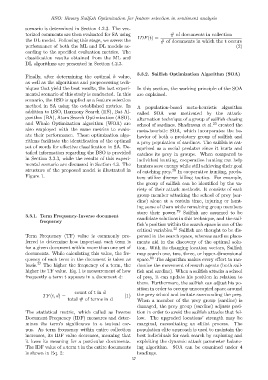
            torized comments are then evaluated for SA using                 # of documents in collection
                                                              IDF(t) =
            the DL model. Following this stage, we assess the           # of documents in which the t occurs
            performance of both the ML and DL models ac-                                                  (2)
            cording to the specified evaluation metrics. The
            classification results obtained from the ML and
            DL algorithms are presented in Section 4.2.3.

                                                              3.3.2. Sailfish Optimization Algorithm (SOA)
            Finally, after determining the optimal k value,
            as well as the algorithms and preprocessing tech-
            niques that yield the best results, the last experi-  In this section, the working principle of the SOA
            mental scenario of this study is conducted. In this  are explained.
            scenario, the BSO is applied as a feature selection
            method in SA using the established metrics. In    A population-based meta-heuristic algorithm
            addition to BSO, Harmony Search (HS), Bat Al-     called SOA was motivated by the attack-
            gorithm (BA), Atom Search Optimization (ASO),     alternation technique of a group of sailfish chasing
            and Whale Optimization algorithm (WOA) are        school of sardines. Shadravan et al. 23  created the
            also employed with the same metrics to evalu-     meta-heuristic SOA, which incorporates the be-
            ate their performance. These optimization algo-   havior of both a predatory group of sailfish and
            rithms facilitate the identification of the optimal  a prey population of sardines. The sailfish is cat-
            set of words for effective classification in SA. De-  egorized as a social predator since it hunts and
            tailed information regarding the BSO is provided  catches its prey in groups. When compared to
            in Section 3.3.3, while the results of this experi-  individual hunting, cooperative hunting can help
            mental scenario are discussed in Section 4.3. The  hunters save energy while still achieving their goal
            structure of the proposed model is illustrated in  of catching prey. 78  In cooperative hunting, preda-
            Figure 1.                                         tors utilize diverse killing tactics. For example,
                                                              the group of sailfish can be identified by the va-
                                                              riety of their attack methods. It consists of each
                                                              group member attacking the school of prey (sar-
                                                              dine) alone at a certain time, injuring or hunt-
                                                              ing some of them while remaining group members
                                                              store their power. 79  Sailfish are assumed to be
            3.3.1. Term Frequency-Inverse document
                                                              candidate solutions in this technique, and the sail-
                   frequency
                                                              fish’s position within the search space is one of the
                                                              critical variables. 23  Sailfish are thought to be dis-
            Term Frequency (TF) value is commonly pre-        persed in the search space, whereas sardine place-
            ferred to determine how important each term is    ments aid in the discovery of the optimal solu-
            for a given document within more than one set of  tion. With its changing location vectors, Sailfish
            documents. While calculating this value, the fre-  may search one, two, three, or hyper-dimensional
            quency of each term in the document is taken as   space. 80  The algorithm makes every effort to ran-
            basis. 77  The higher the frequency of a term, the  domize the movement of search agents (both sail-
            higher its TF value. Eq. 1 is measurement of how  fish and sardine). When a sailfish attacks a school
            frequently a term t appears in a document d:      of prey, it can update his position in relation to
                                                              them. Furthermore, the sailfish can adjust his po-
                                                              sition in order to occupy unoccupied space around
                                  count of t in d
                    TF(t, d) =                          (1)   the prey school and imitate surrounding the prey.
                               total # of terms in d          When a member of the prey group (sardine) is
                                                              damaged, the prey group (sardine) adjusts posi-
            The statistical metric, which called as Inverse   tion in order to avoid the sailfish attacks that fol-
            Document Frequency (IDF) measures and deter-      low. The upgraded locations’ strength may be
            mines the term’s significance in a textual cor-   marginal, necessitating an elitist process. The
            pus. As term frequency within entire collection   population elite approach is used to maintain the
            increases, its IDF value decreases, meaning that  best individuals for each search by exploring and
            it loses its meaning for a particular documents.  exploiting the dynamic attack parameter balanc-
            The IDF value of a term t in the entire documents  ing algorithm. SOA can be examined under 4
            is shown in Eq. 2:                                headings.
                                                            57

