


Page 65 - IJOCTA-15-1
P. 65
BSO: Binary Sailfish Optimization for feature selection in sentiment analysis

            where x i elite sail  is the best position of elite sailfish,  where l is the number of classes (there are two
            x i     is the current position of sardine, α is a  classes in this study: 0 (negative) and 1 (pos-
              old sard
            random number between 0 and 1 and AS shows        itive)).  Feature Selection (FS) method (here,
            the amount of sailfish’s Attack Strength at each  BSO) extracts a subset F sub = {f sub 1  , ..., f sub n },
            iteration that is produced as shown in Eq. 7:     where sub n < t, F sub ⊂ F and F sub has higher
                                                              classification accuracy than any other subset of
                       AS = A ∗ (1 − (2 ∗ Itr ∗ ς))     (7)
                                                              same size or any valid subset of F. The only two
            where A and ς are coefficients for decreasing the  possible solutions to the binary optimization is-
            value of power attack linearly from A to 0 and Itr  sue known as FS are 0 and 1. A binary vector is
            is the current iteration. Sardines move to different  used to express a solution, with 1 meaning that
            locations as soon as a sailfish attacks.          the related word is selected and 0 meaning that
                                                              it is not. This binary vector has the same length
            According to the amount of α and AP character-    as sub n . BSO is a method for solving continuous
            istics, sardines adjust their position to confuse the  optimization problems with real-valued solutions.
            predator and reduce the danger of being discov-   The continuous search space of the BSO is con-
            ered. As previously stated, the attack capability  verted to a binary one using the sigmoid transfer
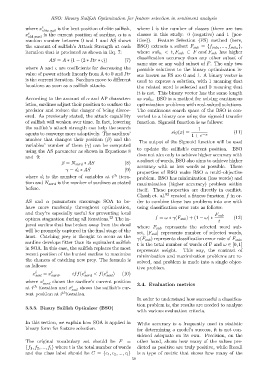
            of sailfish will weaken over time. In fact, lowering  function. Sigmoid function is as follows:
            the sailfish’s attack strength can help the search                           1
            agents to converge more adaptively. The sardines’                sig(x) =      −x            (11)
                                                                                      1 + e
            number that changes their position (β) and the
                                                               The output of the Sigmoid function will be used
            variables’ number of them (γ) can be computed
                                                              to update the sailfish’s current position. BSO
            using the AS parameter as shown in Equations 8
                                                              does not aim only to achieve higher accuracy with
            and 9:
                                                              a subset of words, BSO also aims to achieve higher
                            β = N sard ∗ AS             (8)
                                                              accuracy with as less words as possible. These
                              γ = d i ∗ AS              (9)
                                                              properties of BSO make BSO a multi-objective
            where d i is the number of variables at i th  itera-  problem. BSO has minimization (less words) and
            tion and N sard is the number of sardines as stated  maximization (higher accuracy) problem within
            before.                                           itself. These properties are directly in conflict.
                                                              Ghosh et. al. 82  created a fitness function f in or-
            AS and α parameters encourage SOA to be-          der to combine these two problems into one with
            have more randomly throughout optimization,       using classification error rate as follows:
            and they’re especially useful for preventing local                                  F sub
            optima stagnation during all iterations. 23  The in-      f = ω ∗ γ(F sub ) + (1 − ω) ∗      (12)
                                                                                                  t
            jured sardine that has broken away from the shoal
                                                              where F sub represents the selected word sub-
            will be promptly captured in the final stage of the
                                                              set, |F sub | represents number of selected words,
            hunt. Catching prey is thought to occur as the
                                                              γ(F sub ) represents classification error rate of F sub ,
            sardine develops fitter than its equivalent sailfish  t is the total number of words of F and ω ∈ [0, 1]
            in SOA. In this case, the sailfish replaces the most  represents weight.  This way, the contrast of
            recent position of the hunted sardine to maximize  minimization and maximization problems are re-
            the chances of catching new prey. The formula is  solved, and problem is made into a single objec-
            as follows:
                                                              tive problem.
                x i  = x i  ,    iff(x i   < f(x i  )  (10)
                 sail   sard           sard     sail
            where x i   shows the sardine’s current position
                    sard                                      3.4. Evaluation metrics
            at i th  iteration and x i  shows the sailfish’s cur-
                                 sail
                             th
            rent position at i iteration.
                                                              In order to understand how successful a classifica-
                                                              tion problem is, the results are needed to analyze
            3.3.3. Binary Sailfish Optimizer (BSO)
                                                              with various evaluation criteria.

            In this section, we explain how SOA is applied in  While accuracy is a frequently used in statistic
            binary form for feature selection.                for determining a model’s success, it is not con-
                                                              sidered adequate on its own. Precision, on the
            The original vocabulary set should be F      =    other hand, shows how many of the values pre-
            {f 1 , f 2 , ..., f t } where t is the total number of words  dicted as positive are truly positive, while Recall
            and the class label should be C = {c 1 , c 2 , ..., c l }  is a type of metric that shows how many of the
                                                            59

