


Page 27 - IJOCTA-15-2
P. 27
A. R´acz / IJOCTA, Vol.15, No.2, pp.215-224 (2025)
            and waste costs (CW = 100, CC = 400) as
            in the numerical example. Optimalon offered a
            very short trial period, so only 10 test cases were
            solved. The full data set can be found in Table
            A1. in the Appendix.


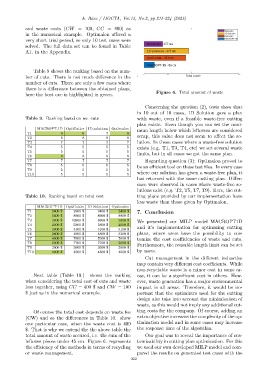
                Table 9 shows the ranking based on the num-
            ber of cuts. There is not much difference in the
            number of cuts. There are only a few cases where
            there is a difference between the obtained plans,
                                                                      Figure 6. Total amount of waste
            here the best one is highlighted in green.

                                                                  Concerning the question (2), tests show that
                                                              in 10 out of 10 cases, 1D Solution gave a plan
            Table 9. Ranking based on no. cuts                with waste, even if a feasible waste-free cutting
                                                              plan exists. Even though you can set the mini-
                  MACROPT-1D OptiCutter 1D solutions Optimalon  mum length below which leftovers are considered
             T1             6         6         7        6
             T2             8         8         8        8    scrap, this value does not seem to affect the so-
             T3             7         7         7        7    lution. In those cases where a waste-free solution
             T4             5         5         5        5    exists (e.g. T1, T3, T4, etc) we set several waste
             T5             5         5         5        5    limits, but in all cases we got the same plan.
             T6             6         8         8        8
             T7             7         7         7        7        Regarding question (3): Optimalon proved to
             T8             5         5         5        5    be an efficient tool on these test files. In every case
             T9             5         5         5        5
             T10            5         5         5        5    where our solution has given a waste-free plan, it
                                                              has returned with the same cutting plan. Differ-
                                                              ence were observed in cases where waste-free so-
                                                              lutions exist (e.g. T2, T5, T7, T9). Here, the cut-
            Table 10. Ranking based on total cost             ting plans provided by our implementation have
                                                              less waste than those given by Optimalon.
                  MACROPT-1D OptiCutter 1D Solutions Optimalon
             T1         2400 $    2900 $    9400 $    2400 $  7. Conclusion
             T2         5600 $    8900 $    8900 $    8900 $
             T3         2800 $   10900 $    6900 $    2800 $  We presented our MILP model MACROPT1D
             T4         2000 $    5800 $    5800 $    2000 $
             T5         3000 $    3100 $    3100 $    3100 $  and it’s implementation for optimizing cutting
             T6         2400 $    4800 $    4800 $    3200 $  plans, where users have the possibility to cus-
             T7         4600 $    7600 $    7600 $    7600 $  tomize the cost coefficiencies of waste and cuts.
             T8         2000 $    7700 $    7700 $    2000 $  Furthermore, the reusable length limit can be set
             T9         3600 $    3600 $    3600 $    3600 $
             T10        4000 $    4500 $    4500 $    4500 $  by users.
                                                                  Cut management in the different indusrties
                                                              may contain very different cost coefficients. While
                                                              non-recyclable waste is a minor cost in some ar-
                Next table (Table 10.)   shows the ranking    eas, it can be a significant cost in others. How-
            when considering the total cost of cuts and waste  ever, waste generation has a major environmental
            loss together, using CC = 400 $ and CW = 100      impact in all areas. Therefore, it would be im-
            $ just as in the numerical example.               portant that the optimizers used for the cutting
                                                              design also take into account the minimization of
                                                              waste, as this would not imply any additional cut-
                Of course the total cost depends on waste fee  ting costs for the company. Of course, adding an
            (CW) and so the differences in Table 10. show     extra objective increases the complexity of the op-
            one particular case, when the waste cost is 400   timization model and in some cases may increase
            $. That is why we extend the the above table the  the response time of the algorithm.
            total amount of waste accured, i.e. the sum of the    Our goal was to reveal the importance of cus-
            leftover pieces under 45 cm. Figure 6. represents  tomizability in cutting plan optimization. For this
            the efficiency of the methods in terms of recycling  we used our own developed MILP model and com-
            or waste management.                              pared the results on generated test cases with the
                                                           222

