


Page 200 - IJOCTA-15-4
P. 200
Z. Chen et al. / IJOCTA, Vol.15, No.4, pp.738-749 (2025)
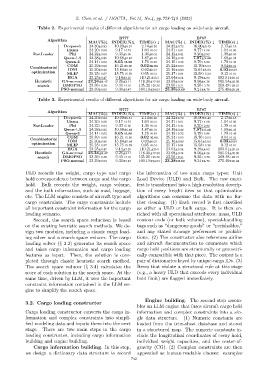
                  Table 2. Experimental results of different algorithms for air cargo loading on wide-body aircraft.

                                                      B777                              B787
                      Algorithm
                                        MAC(%)↓    INDEX(%)↓   TIME(s) ↓  MAC(%) ↓   INDEX(%) ↓   TIME(s) ↓
                             Deepseek    24.30±0.82  10.00±6.51  2.14±0.20  24.32±0.72  10.00±5.43  2.17±0.18
                               Llama     24.20±0.58  9.17±4.73  1.04±0.01  24.31±0.61  9.77±4.58   1.04±0.00
                FastLoader      Phi      24.22±0.64  9.33±5.05  1.36±0.01  24.12±0.41  8.20±2.82   1.39±0.05
                             Qwen-1.5    24.38±0.85  10.68±6.84  1.87±0.10  24.10±0.48  7.97±3.44  1.68±0.35
                              Qwen-3     24.14±0.62  8.65±5.08  1.76±0.49  24.19±0.72  8.79±5.86   1.70±0.46
                               COM       25.39±0.98  16.21±5.80  0.02±0.01  25.24±0.83  15.76±5.03  0.04±0.01
              Combinatorial    IOM       25.30±0.96  15.84±5.64  0.03±0.01  25.16±0.80  15.61±5.03  0.03±0.01
               optimization
                               MLIP      25.25±0.97  15.75±5.78  0.05±0.01  25.17±0.84  15.58±5.20  0.12±0.01
                               HGA       23.25±0.47  9.14±3.25  110.21±25.5  23.64±0.24  9.19±4.82  183.91±20.16
                 Heuristic   GA-normal  23.24±0.47  9.26±3.11  118.30±17.98  23.68±0.24  9.56±4.36  185.54±20.95
                  search     DMOPSO      23.36±0.38  9.40±4.10  135.21±26.36  23.56±0.31  9.25±3.78  269.48±28.15
                            PSO-normal   23.39±0.69  9.30±3.47  160.19±24.63  23.38±0.69  9.21±4.78  275.49±20.24
                  Table 3. Experimental results of different algorithms for air cargo loading on wide-body aircraft.

                                                      B777                              B787
                      Algorithm
                                        MAC(%)↓    INDEX(%)↓   TIME(s) ↓  MAC(%) ↓   INDEX(%) ↓   TIME(s) ↓
                             Deepseek    24.30±0.82  10.00±6.51  2.14±0.20  24.32±0.72  10.00±5.43  2.17±0.18
                               Llama     24.20±0.58  9.17±4.73  1.04±0.01  24.31±0.61  9.77±4.58   1.04±0.00
                FastLoader      Phi      24.22±0.64  9.33±5.05  1.36±0.01  24.12±0.41  8.20±2.82   1.39±0.05
                             Qwen-1.5    24.38±0.85  10.68±6.84  1.87±0.10  24.10±0.48  7.97±3.44  1.68±0.35
                              Qwen-3     24.14±0.62  8.65±5.08  1.76±0.49  24.19±0.72  8.79±5.86   1.70±0.46
                               COM       25.39±0.98  16.21±5.80  0.02±0.01  25.24±0.83  15.76±5.03  0.04±0.01
              Combinatorial
                               IOM       25.30±0.96  15.84±5.64  0.03±0.01  25.16±0.80  15.61±5.03  0.03±0.01
               optimization    MLIP      25.25±0.97  15.75±5.78  0.05±0.01  25.17±0.84  15.58±5.20  0.12±0.01
                               HGA       23.25±0.47  9.14±3.25  110.21±25.5  23.64±0.24  9.19±4.82  183.91±20.16
                 Heuristic   GA-normal  23.24±0.47  9.26±3.11  118.30±17.98  23.68±0.24  9.56±4.36  185.54±20.95
                  search     DMOPSO      23.36±0.38  9.40±4.10  135.21±26.36  23.56±0.31  9.25±3.78  269.48±28.15
                            PSO-normal   23.39±0.69  9.30±3.47  160.19±24.63  23.38±0.69  9.21±4.78  275.49±20.24
            ULD records the weight, cargo type and cargo      the information of two main cargo types: Unit
            hold correspondence between cargo and the cargo   Load Device (ULD) and Bulk. The raw mani-
            hold.  Bulk records the weight, cargo volume,     fest is transformed into a high-resolution descrip-
            and the bulk information, such as mail, luggage,  tion of every freight item so that optimization
            etc. The LLM engine consists of aircraft type and  algorithms can consume the data with no fur-
            cargo constraints. The cargo constraints include  ther cleaning. (1) Each record is first classified
            all important constraint information for the cargo  as either a ULD or bulk cargo. It is then en-
            loading scenario.                                 riched with all operational attributes: mass, ULD
                Second, the search space reduction is based   contour code (or bulk volume), special-handling
            on the existing heuristic search methods. We de-  tags such as “dangerous goods” or “perishables,”
            sign two modules, including a classic cargo load-  and any stated stowage preferences or prohibi-
            ing solver and a search space reducer. The cargo  tions. (2) The constructor also references airline
            loading solver (§ 3.3) generates its search space  and aircraft documentation to enumerate which
            and takes cargo information and cargo loading     cargo hold positions are structurally or geometri-
            features as input.  Then, the solution is com-    cally compatible with that piece. The output is a
            pleted through classic heuristic search method.   pair of dictionaries keyed by unique cargo IDs. (3)
            The search space reducer (§ 3.4) calculates the   Items that violate a structural rule at this stage
            score of each solution in the search space. At the  (e.g., a heavy ULD that exceeds every individual
            same time, driven by LLM, it uses the important   hold limit) are flagged immediately.
            constraint information contained in the LLM en-
            gine to simplify the search space.

                                                                  Engine building. The second step assem-
            3.2. Cargo loading constructor
                                                              bles an LLM engine that fuses aircraft cargo hold
            Cargo loading constructor converts the cargo in-  information and complex constraints into a sin-
            formation and complex constraints into simpli-    gle data structure.  (1) Numeric constants are
            fied modeling data and inputs them into the next  loaded from the trim-sheet database and stored
            stage. There are two main steps in the cargo      in a structured map. The numeric constants in-
            loading constructor, including cargo information  clude the longitudinal coordinates of every hold,
            building and engine building.                     individual weight capacities, and the center-of-
                Cargo information building. In this step,     gravity (CG). (2) Complex constraints are then
            we design a dictionary data structure to record   appended as human-readable clauses: examples
                                                           742

