


Page 28 - IJPS-2-2
P. 28
Assessments of mortality at oldest-old ages by province in China's 2000 and 2010 censuses
Appendix A
Notes:
1. The observed infant mortality rate for China in the 2010 census was less than 4‰, lower than the
level of the UK in the same year (which is not plausible) and more than 70% lower than that ob-
served in the Maternal and Child Mortality Surveillance System in China (http://www.child-
mortality.org/index.php?r=site/graph#ID=CHN_China).
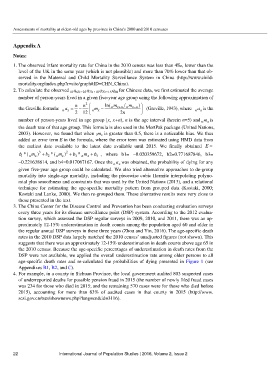
2. To calculate the observed q , q , q , q for Chinese data, we first estimated the average
10 60 25 70 10 70 15 80
number of person-years lived in a given five-year age group using the following approximation of
n n 2 ln( m m )
+
−
the Greville formula: a = nx 2 − 12 n m − x n x n n x n (Greville, 1943), where a is the
nx
2n
number of person-years lived in age group [x, x+n), n is the age interval (herein n=5) and m is
n
x
the death rate of that age group. This formula is also used in the MortPak package (United Nations,
2003). However, we found that when 5m x is greater than 0.5, there is a noticeable bias. We thus
added an error term E in the formula, where the error term was estimated using HMD data from
the earliest date available to the latest date available until 2015. We finally obtained E =
b 1 *( m x ) + 3 b 2 *( m x ) + 2 b 3 * m + n x b , where b1= −0.020359672, b2=0.771687846, b3=
n
n
4
−0.221638614, and b4=0.017067167. Once the a was obtained, the probability of dying for any
nx
given five-year age group could be calculated. We also tried alternative approaches to de-group
mortality into single-age mortality, including the piecewise cubic Hermite interpolating polyno-
mial plus smoothness and constraints that was used by the United Nations (2013), and a relational
technique for estimating the age-specific mortality pattern from grouped data (Kostaki, 2000;
Kostaki and Lanke, 2000). We then re-grouped them. These alternative results were very close to
those presented in the text.
3. The China Center for the Disease Control and Prevention has been conducting evaluation surveys
every three years for its disease surveillance point (DSP) system. According to the 2012 evalua-
tion survey, which assessed the DSP regular surveys in 2009, 2010, and 2011, there was an ap-
proximately 12-15% underestimation in death counts among the population aged 60 and older in
the regular annual DSP surveys in these three years (Zhou and Yin, 2016). The age-specific death
rates in the 2010 DSP data largely matched the 2010 census’ unadjusted figures (not shown). This
suggests that there was an approximately 12-15% underestimation in death counts above age 65 in
the 2010 census. Because the age-specific percentages of underestimation in death rates from the
DSP were not available, we applied the overall underestimation rate among older persons to all
age-specific death rates and re-calculated the probabilities of dying presented in Figure 1 (see
Appendixes B1, B2, and C).
4. For example, in a county in Sichuan Province, the local government audited 803 suspected cases
of underreported deaths for possible pension fraud in 2015 (the number of newly filed fraud cases
was 234 for those who died in 2015; and the remaining 570 cases were for those who died before
2015), accounting for more than 83% of audited cases in that county in 2015 (http://www.
scsi.gov.cn/tszs/shownews.php?lang=cn&id=3116).
22 International Journal of Population Studies | 2016, Volume 2, Issue 2

