


Page 40 - IJPS-2-2
P. 40
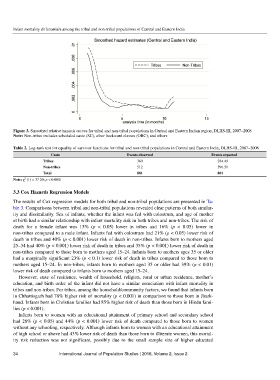
Infant mortality differentials among the tribal and non-tribal populations of Central and Eastern India


       Figure 3. Smoothed relative hazards curves for tribal and non-tribal populations in Central and Eastern Indian region, DLHS-III, 2007–2008
       Note: Non-tribes includes scheduled caste (SC), other backward classes (OBC), and others

       Table 2. Log-rank test for equality of survivor functions for tribal and non-tribal populations in Central and Eastern India, DLHS-III, 2007–2008
                       Caste                           Events observed                     Events expected
                   Tribes                                  369                                284.49
                   Non-tribes                              512                                596.51
                   Total                                   881                                881
           2
       Note: χ  (1) = 37.20; p < 0.0001

       3.3 Cox Hazards Regression Models

       The results of Cox regression models for both tribal and non-tribal populations are presented in Ta-
       ble 3. Comparisons between tribal and non-tribal populations revealed clear patterns of both similar-
       ity and dissimilarity. Sex of infants, whether the infant was fed with colostrum, and age of mother
       at birth had a similar relationship with infant mortality risk in both tribes and non-tribes. The risk of
       death for a female infant  was 15% (p  < 0.05) lower in tribes  and  16% (p  <  0.05) lower in
       non-tribes compared to a male infant. Infants fed with colostrum had 21% (p < 0.05) lower risk of
       death in tribes and 40% (p < 0.001) lower risk of death in non-tribes. Infants born to mothers aged
       25–34 had 40% (p < 0.001) lower risk of death in tribes and 35% (p < 0.001) lower risk of death in
       non-tribes compared to those born to mothers aged 15–24. Infants born to mothers ages 35 or older
       had a marginally significant 23% (p < 0.1) lower risk of death in tribes compared to those born to
       mothers aged 15–24. In non-tribes, infants born to mothers aged 35 or older had 39% (p < 0.01)
       lower risk of death compared to infants born to mothers aged 15–24.
         However, state of residence, wealth  of household, religion, rural  or urban residence, mother’s
       education, and birth order of the infant did not have a similar association with infant mortality in
       tribes and non-tribes. For tribes, among the household/community factors, we found that infants born
       in Chhattisgarh had 78% higher risk of mortality (p < 0.001) in comparison to those born in Jhark-
       hand. Infants born in Christian families had 85% higher risk of death than those born in Hindu fami-
       lies (p < 0.001).
         Infants born to women with an educational attainment of primary school and secondary school
       had 26% (p < 0.05) and 44% (p < 0.001) lower risk of death compared to those born to women
       without any schooling, respectively. Although infants born to women with an educational attainment
       of high school or above had 43% lower risk of death than those born to illiterate women, this mortal-
       ity risk reduction was not  significant, possibly due to the small sample size of higher educated


       34                 International Journal of Population Studies | 2016, Volume 2, Issue 2

