


Page 41 - IJPS-2-2
P. 41
Mukesh Ranjan,  Laxmi Kant Dwivedi,  Rahul Mishra,  et al.

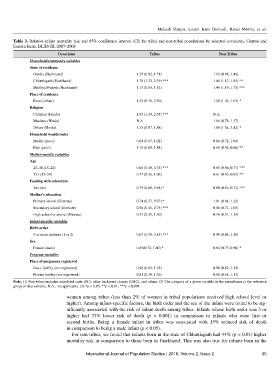
       Table 3. Relative infant mortality risk and 95% confidence interval (CI) for tribal and non-tribal populations by selected covariates, Central and
       Eastern India, DLHS-III, 2007–2008
                          Covariates                             Tribes                       Non-Tribes
              Household/community variables

                State of residence
               Odisha (Jharkhand)                          1.25 (0.92, 1.71)                1.13 (0.88, 1.44)
               Chhattisgarh (Jharkhand)                    1.78 (1.32, 2.39) ***            1.44 (1.13, 1.85) **
               Madhya Pradesh (Jharkhand)                  1.13 (0.85, 1.52)                1.44 (1.19, 1.73) ***
              Place of residence
               Rural (urban)                               1.32 (0.76, 2.30)                1.29 (1.02, 1.63) *
              Religion
               Christian (Hindu)                           1.85 (1.34, 2.55) ***            N.A.
               Muslims (Hindu)                             N.A.                             1.04 (0.78, 1.37)
               Others (Hindu)                              1.35 (0.97, 1.88)                1.88 (1.04, 3.42) *
              Household wealth index
               Middle (poor)                               0.69 (0.47, 1.02)                0.86 (0.72, 1.04)
               Rich (poor)                                 1.10 (0.65, 1.88)                0.68 (0.54, 0.86) **
              Mother-specific variables
              Age
               25–34 (15–24)                               0.60 (0.49, 0.73) ***            0.65 (0.56, 0.77) ***
               35+ (15–24)                                 0.77 (0.56, 1.06)                0.61 (0.45, 0.83) **
              Feeding with colostrum
               Yes (no)                                    0.79 (0.65, 0.98) *              0.60 (0.51, 0.71) ***
              Mother’s education
               Primary school (illiterate)                 0.74 (0.57, 0.97) *              1.01 (0.84, 1.22)
               Secondary school (illiterate)               0.56 (0.41, 0.75) ***            0.86 (0.71, 1.05)
               High school or above (illiterate)           0.57 (0.25, 1.30)                0.76 (0.51, 1.13)
              Infant-specific variables
              Birth order
               3 or more children (1 or 2)                 0.67 (0.55, 0.83) ***            0.99 (0.84, 1.18)
                Sex
               Female (male)                               0.85(0.72, 1.00) *               0.84 (0.73, 0.96) *
              Program variables
              Place of pregnancy registered
               Govt. facility (not registered)             0.98 (0.82, 1.18)                0.96 (0.82, 1.12)
               Private facility (not registered)           0.81 (0.48, 1.36)                0.88 (0.68, 1.14)
       Note: (1) Non-tribes includes scheduled caste (SC), other backward classes (OBC), and others. (2) The category of a given variable in the parentheses is the reference
       group of that variable. N.A.: not applicable. (3) *p < 0.05, **p < 0.01, ***p < 0.001.

                             women among tribes (less than 2% of women in tribal populations received high school level or
                             higher). Among infant-specific factors, the birth order and the sex of the infant were found to be sig-
                             nificantly associated with the risk of infant death among tribes. Infants whose birth order was 3 or
                             higher had 33% lower risk of death (p  < 0.001) in comparison to infants who were first or
                             second  births. Being a female infant in tribes was  associated with 15% reduced risk  of death
                             in comparison to being a male infant (p < 0.05).
                                For non-tribes, we found that infants born in the state of Chhattisgarh had 44% (p < 0.01) higher
                             mortality risk in comparison to those born in Jharkhand. This was also true for infants born in the

                                     International Journal of Population Studies | 2016, Volume 2, Issue 2      35

