


Page 10 - IMO-1-1
P. 10
Innovative Medicines & Omics                                         Antioxidant nanomedicines for therapies


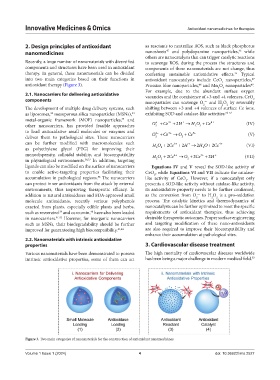
            2. Design principles of antioxidant                as reactants to neutralize ROS, such as black phosphorus
                                                                                                       46
                                                                        45
            nanomedicines                                      nanosheets   and  polydopamine  nanoparticles,   while
                                                               others are nanocatalysts that can trigger catalytic reactions
            Recently, a large number of nanomaterials with diversified   to scavenge ROS, during the process the structures and
            components and structures have been used in antioxidant   components of these nanomaterials are not change, thus
            therapy.  In  general,  these  nanomaterials  can  be  divided   conferring  sustainable  antioxidative  effects.  Typical
                                                                                                     25
            into two main categories based on their functions in   antioxidant nanocatalysts include CeO  nanoparticles,
                                                                                                            47
                                                                                               2
            antioxidant therapy (Figure 3).                    Prussian blue nanoparticles,  and Mn O  nanoparticles .
                                                                                      48
                                                                                                            49
                                                                                                4
                                                                                              3
                                                               For example, due to the abundant surface oxygen
            2.1. Nanocarriers for delivering antioxidative     vacancies and the coexistence of +3 and +4 valences, CeO
                                                                                                             2
            components                                         nanoparticles can scavenge O  and H O  by reversibly
                                                                                        •−
                                                                                               2
                                                                                                 2
                                                                                       2
            The development of multiple drug delivery systems, such   shifting between +3 and +4 valences of surface Ce ions,
            as liposomes,  mesoporous silica nanoparticles (MSNs),    exhibiting SOD and catalase-like activities: 50-52
                      33
                                                         34
            metal-organic  framework  (MOF)  nanoparticles,  and       3               4
                                                     35
            other  nanocarriers,  has  provided  feasible  approaches   O  Ce  2 H  HO  Ce            (IV)
                                                                                      2
                                                                                    2
                                                                   2
            to load antioxidative small molecules or enzymes and   O  Ce 4   O  Ce                    (V)

                                                                                   3
            deliver  them  to  pathological  sites.  These  nanocarriers   2  2
            can be further modified with macromolecules such      HO   2 Ce  2 H  2 H O 2  Ce         (VI)
                                                                                              4

                                                                           3
            as  polyethylene  glycol  (PEG)  for  improving  their   2  2              2
            monodispersity, colloidal stability, and biocompatibility   HO  2 Ce 4   O  2 Ce  2 H    (VII)
                                                                                      3

            in  physiological  environments. 36,37   In  addition,  targeting   2  2  2
            ligands can also be modified on the surface of nanocarriers   Equations IV  and  V  reveal  the  SOD-like  activity  of
            to  enable  active-targeting  properties  facilitating  their   CeO , while Equations VI and VII indicate the catalase-
                                                                   2
            accumulation in pathological regions.  The nanocarriers   like activity of CeO .  However,  if  a  nanocatalyst  only
                                           38
                                                                                2
            can protect inner antioxidants from the attack by external   presents a SOD-like activity without catalase-like activity,
            environments,  thus  improving  therapeutic  efficacy.  In   its antioxidative property needs to be further confirmed,
            addition to natural antioxidases and FDA-approved small   as the conversion from O  to H O   is  a  pro-oxidation
                                                                                     •−
                                                                                             2
                                                                                           2
                                                                                    2
            molecule antioxidants, recently various polyphenols   process.  The  catalytic  kinetics  and  thermodynamics  of
            exacted from plants, especially edible plants and herbs,   nanocatalysts can be further optimized to meet the specific
            such as resveratrol  and curcumin,  have also been loaded   requirements  of  antioxidant  therapies,  thus  achieving
                          39
                                        40
            in  nanocarriers. 41,42  However, for inorganic  nanocarriers   desirable therapeutic outcomes. Proper surface engineering
            such as MSNs, their biodegradability should be further   and  targeting  modification  of  these  nano-antioxidants
            improved for guaranteeing high biocompatibility. 43,44  are  also  required  to  improve  their  biocompatibility  and
                                                               enhance their accumulation at pathological sites.
            2.2. Nanomaterials with intrinsic antioxidative
            properties                                         3. Cardiovascular disease treatment
            Various nanomaterials have been demonstrated to possess   The high mortality of cardiovascular diseases worldwide
            intrinsic antioxidative properties, some of them can act   has been being a major challenge in modern medical field.
                                                                                                            53

            Figure 3. Two main categories of nanomaterials for the construction of antioxidant nanomedicines.


            Volume 1 Issue 1 (2024)                         4                                doi: 10.36922/imo.2527

