


Page 15 - IMO-1-1
P. 15
Innovative Medicines & Omics                                         Antioxidant nanomedicines for therapies


            A


            B


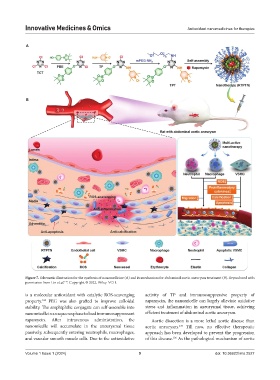
            Figure 7. Schematic illustration for the synthesis of nanomedicine (A) and its mechanism for abdominal aortic aneurysm treatment (B). Reproduced with
            permission from Lin et al. . Copyright © 2022, Wiley-VCH.
                            133

            is  a  molecular  antioxidant  with  catalytic  ROS-scavenging   activity  of  TP  and  immunosuppressive  property  of
            property.   PEG  was  also  grafted  to  improve  colloidal   rapamycin, the nanomicelle can largely alleviate oxidative
                   134
            stability. The amphiphilic conjugate can self-assemble into   stress and inflammation in aneurysmal tissue, achieving
            nanomicelle in an aqueous phase to load immunosuppressant   efficient treatment of abdominal aortic aneurysm.
            rapamycin.   After   intravenous   administration,   the   Aortic dissection is a more lethal aortic disease than
            nanomicelle  will  accumulate in the aneurysmal tissue   aortic  aneurysm.  Till now, no effective therapeutic
                                                                             135
            passively, subsequently entering neutrophils, macrophages,   approach has been developed to prevent the progression
            and vascular smooth muscle cells. Due to the antioxidative   of this disease.  As the pathological mechanism of aortic
                                                                           136

            Volume 1 Issue 1 (2024)                         9                                doi: 10.36922/imo.2527

