


Page 18 - IMO-1-1
P. 18
Innovative Medicines & Omics                                         Antioxidant nanomedicines for therapies


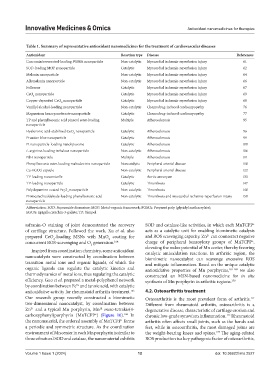
            Table 1. Summary of representative antioxidant nanomedicines for the treatment of cardiovascular diseases
            Antioxidant                             Reaction type  Disease                            References
            Curcumin/resveratrol-loading PGMA nanoparticle  Non-catalytic  Myocardial ischemia-reperfusion injury  61
            SOD-loading MOF nanoparticle            Catalytic   Myocardial ischemia-reperfusion injury  62
            Melanin nanoparticle                    Non-catalytic  Myocardial ischemia-reperfusion injury  64
            Allomelanin nanoparticle                Non-catalytic  Myocardial ischemia-reperfusion injury  66
            Fullerene                               Catalytic   Myocardial ischemia-reperfusion injury  67
            CeO  nanoparticle                       Catalytic   Myocardial ischemia-reperfusion injury  69
               2
            Copper-deposited CeO  nanoparticle      Catalytic   Myocardial ischemia-reperfusion injury  68
                           2
            Vanillyl alcohol-loading nanoparticle   Non-catalytic  Chemodrug-induced cardiomyopathy     76
            Magnesium hexacyanoferrate nanoparticle  Catalytic  Chemodrug-induced cardiomyopathy        77
            TP and phenylboronic acid pinacol ester-loading   Multiple  Atherosclerosis                 95
            nanoparticle
            Hyaluronic acid-stabilized CeO  nanoparticle  Catalytic  Atherosclerosis                    96
                                2
            Prussian blue nanoparticle              Catalytic   Atherosclerosis                         99
            Pt nanoparticle-loading nanoliposome    Catalytic   Atherosclerosis                         100
            L-arginine-loading trehalose nanoparticle  Non-catalytic  Atherosclerosis                   106
            PdH nanoparticle                        Multiple    Atherosclerosis                         111
            Phenyl boronic ester-loading maltodextrin nanoparticle  Noncatalytic  Peripheral arterial disease  118
            Cu-EGCG capsule                         Non-catalytic  Peripheral arterial disease          122
            TP-loading nanomicelle                  Catalytic   Aortic aneurysm                         133
            TP-loading nanoparticle                 Catalytic   Thrombosis                              147
            Polydopamine-coated Fe O  nanoparticle  Non-catalytic  Thrombosis                           148
                            3
                              4
            Protocatechualdehyde-loading phenylboronic acid   Non-catalytic  Thrombosis and myocardial ischemia-reperfusion injury  150
            nanoparticle
            Abbreviation: SOD: Superoxide dismutase; MOF: Metal-organic framework; PGMA: Prepared poly (glycidyl methacrylate);
            EGCG: Epigallocatechin-3-gallate; TP: Tempol

            safranin-O  staining  of  joint  demonstrated  the  recovery   SOD and catalase-like activities, in which each MnTCPP
                                                                                                             +
            of  cartilage  structure.  Followed  the  work,  Xu  et al. also   acts as a catalytic unit for enabling biomimetic catalysis
                                                                                         2+
            prepared CeO -loading  MSNs  with  MnO  coating for   and ROS scavenging capacity. Zn  can counteract negative
                                               2
                        2
                                                                                                            +
            concurrent ROS-scavenging and O  generation. 164   charge  of  peripheral  benzoyloxy  groups  of  MnTCPP ,
                                        2
              Inspired from coordination chemistry, some antioxidant   elevating the redox potential of Mn center, thereby favoring
                                                               catalytic  antioxidation  reactions.  In  arthritic  region,  the
            nanocatalysts  were  constructed  by  coordination  between   biomimetic nanocatalyst can scavenge excessive ROS
            transition metal ions and organic ligands, of which the   and mitigate inflammation. Based on the unique catalytic
            organic ligands can regulate the catalytic kinetics and   antioxidative properties of Mn porphyrins, 167-169  we also
            thermodynamics of metal ions, thus regulating the catalytic   constructed  an  MSN-based  nanomedicine  for  in situ
            efficiency. Guo et al. prepared a metal-polyphenol network   synthesis of Mn porphyrin in arthritic regions. 170
            by coordination between Fe  and tannic acid, with catalytic
                                 3+
            antioxidative activity for rheumatoid arthritis treatment.    4.2. Osteoarthritis treatment
                                                         165
            Our research group recently constructed a biomimetic   Osteoarthritis  is  the  most  prevalent  form  of  arthritis.
                                                                                                            171
            two-dimensional  nanocatalyst,  by  coordination  between   Different from rheumatoid arthritis, osteoarthritis is a
                                           III
            Zn  and a typical Mn porphyrin, Mn   meso-tetrakis(4-  degenerative disease, characteristic of cartilage erosion and
              2+
            carboxyphenyl)porphyrin  (MnTCPP ) (Figure  10).   In   chronic low-grade synovium inflammation.  Rheumatoid
                                                      166
                                         +
                                                                                                 172
                                                     +
            the nanomaterial, the ordered assembly of MnTCPP  forms   arthritis often affects small joints, such as the hands and
            a periodic and symmetric structure. As the coordination   feet, while in osteoarthritis, the most damaged joints are
            environment of Mn center in each Mn porphyrin is similar to   the weight-bearing knees and spines.  The aging-related
                                                                                             173
            those of natural SOD and catalase, the nanomaterial exhibits   ROS production is a key pathogenic factor of osteoarthritis,
            Volume 1 Issue 1 (2024)                         12                               doi: 10.36922/imo.2527

