


Page 22 - IMO-1-1
P. 22
Innovative Medicines & Omics                                         Antioxidant nanomedicines for therapies


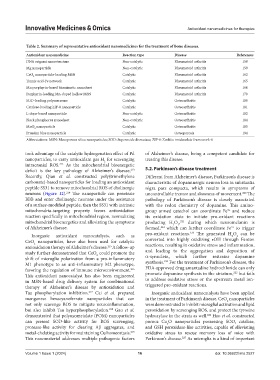
            Table 2. Summary of representative antioxidant nanomedicines for the treatment of bone diseases.
            Antioxidant nanomedicine                 Reaction type         Disease                    References
            DNA origami nanostructure                Non-catalytic         Rheumatoid arthritis         158
            Mg nanoparticle                          Non-catalytic         Rheumatoid arthritis         159
            CeO  nanoparticle-loading MSN            Catalytic             Rheumatoid arthritis         162
               2
            Tannic acid-Fe network                   Catalytic             Rheumatoid arthritis         165
            Mn porphyrin-based biomimetic nanosheet  Catalytic             Rheumatoid arthritis         166
            Porphyrin-loading Mn-doped hollow MSN    Catalytic             Rheumatoid arthritis         170
            SOD-loading polymersome                  Catalytic             Osteoarthritis               180
            Catalase-loading ZIF-8 nanoparticle      Catalytic             Osteoarthritis               181
            L-dopa-based nanoparticle                Non-catalytic         Osteoarthritis               182
            Black phosphorus nanosheet               Non-catalytic         Osteoarthritis               184
            MnO  nanoparticle                        Catalytic             Osteoarthritis               185
                2
            Prussian blue nanoparticle               Catalytic             Osteoporosis                 194
            Abbreviations: MSN: Mesoporous silica nanoparticles; SOD: Superoxide dismutase; ZIF-8: Zeolitic imidazolate framework-8


            took advantage of the catalytic hydrogenation effect of Pd   of  Alzheimer’s  disease,  being  a  competent  candidate  for
            nanoparticles, to carry antioxidant gas H  for scavenging   treating this disease.
                                             2
            intracranial  ROS.   As  the  mitochondrial  bioenergetic
                          212
            deficit  is  the  key  pathology  of  Alzheimer’s  disease,    5.2. Parkinson’s disease treatment
                                                         213
            Recently,  Qian  et al. constructed poly(trimethylene   Different from Alzheimer’s disease, Parkinson’s disease is
            carbonate)-based nanoparticles for loading an antioxidant   characteristic of dopaminergic neuron loss in substantia
            peptide SS31 to remove mitochondrial ROS of cholinergic   nigra pars compacta, which results in symptoms of
            neurons (Figure  12).  The nanoparticle can penetrate   uncontrollable tremor and slowness of movement.  The
                             214
                                                                                                        220
            BBB and enter cholinergic neurons under the assistance   pathology  of  Parkinson’s  disease  is  closely  associated
            of a surface-modified peptide, then the SS31 with intrinsic   with  the  redox  chemistry  of  dopamine.  This  amino-
            mitochondria-targeting  property  favors  antioxidation   group armed catechol can coordinate Fe  and reduce
                                                                                                  3+
            reaction specifically in mitochondrial region, normalizing   its  oxidation  state  to  initiate  pro-oxidant  reactions
            mitochondrial bioenergetics and alleviating the symptoms   producing  H O ,   during  which  neuromelanin  is
                                                                              221
                                                                             2
                                                                           2
            of Alzheimer’s disease.                            formed,  which can further coordinate Fe  to trigger
                                                                                                   3+
                                                                     222
                                                                                  223
              Inorganic   antioxidant   nanocatalysts,   such   as   pro-oxidant  reactions.  The generated H O  can be
                                                                                                      2
                                                                                                    2
            CeO  nanoparticles, have also been used for catalytic   converted  into  highly  oxidizing  •OH  through  Fenton
                2
            antioxidation therapy of Alzheimer’s disease.  A follow-up   reactions, resulting in oxidative stress and inflammation,
                                               215
            study further demonstrated that CeO  could promote the   and leading to the aggregation and deposition of
                                          2
            shift  of  microglia  polarization  from  a  pro-inflammatory   α-synuclein,  which  further  restrains  dopamine
                                                                       224
            M1  phenotype  to  an  anti-inflammatory  M2  phenotype,   synthesis.  For the treatment of Parkinson’s disease, the
            favoring the regulation of immune microenvironment.    FDA-approved drug amantadine hydrochloride can only
                                                         216
                                                                                                    225
            This antioxidant nanocatalyst has also been engineered   promote dopamine synthesis in the striatum,  but fails
            in  MSN-based  drug  delivery  system  for  combinational   to  address  oxidative  stress  or  the  upstream  metal  ion-
            therapy  of  Alzheimer’s  disease  by  antioxidation  and   triggered pro-oxidant reactions.
            Tau  phosphorylation  inhibition.  Cai  et al. prepared   Inorganic antioxidant nanocatalysts have been applied
                                       217
            manganese hexacyanoferrate nanoparticles that can   in the treatment of Parkinson’s disease. CeO  nanoparticles
                                                                                                  2
            not only scavenge ROS to mitigate neuroinflammation,   were demonstrated to inhibit microglial activation and lipid
            but  also  inhibit  Tau  hyperphosphorylation.  Gao  et al.   peroxidation by scavenging ROS, and protect the tyrosine
                                               218
            demonstrated that polyoxometalate (POM) nanoparticles   hydroxylase in the strata as well.  Hao et al. constructed
                                                                                         226
            can  present  SOD-like  activity  for  ROS  scavenging,   porous Cu O nanoparticles possessing SOD, catalase,
                                                                        x
            protease-like  activity  for  clearing  Aβ aggregates, and   and GSH peroxidase-like activities, capable of alleviating
            metal-chelating activity for maintaining Cu homeostasis.    oxidative stress to rescue memory loss of mice with
                                                         219
            This nanomaterial addresses multiple pathogenic factors   Parkinson’s disease.  As microglia is a kind of important
                                                                              227
            Volume 1 Issue 1 (2024)                         16                               doi: 10.36922/imo.2527

