


Page 127 - IMO-1-1
P. 127
Innovative Medicines & Omics                              Promising molecule against SARS-CoV-2 nucleocapsid


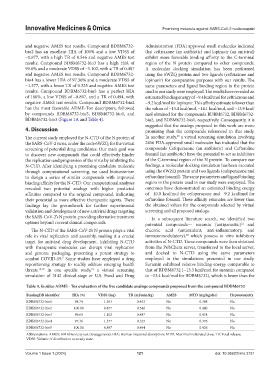
            and negative AMES test results. Compound BDBM6732-  Administration (FDA) approved small molecules indicated
            bio2  has  an  excellent  HIA  of  100%  and  a  low  VDSS  of   that ceftriaxone (an antibiotic) and lopinavir (an antiviral)
            −0.877, with a high TR of 0.546 and negative AMES test   exhibit more favorable binding affinity to the C-terminal
            results. Compound BDBM6732-bio3 has a high HIA of   region of the N protein compared to other compounds.
            99.6% and a moderate VDSS of −1.102, with a TR of 0.487   A  molecular docking simulation has been performed
            and negative AMES test results. Compound BDBM6732-  using the 6WZQ protein and two ligands (ceftriaxone and
            bio4 has a lower HIA of 97.36% and a moderate VDSS of   lopinavir)  for  comparative  purposes  with  our  results.  The
            −1.377, with a lower TR of 0.325 and negative AMES test   same parameters and ligand binding region in the protein
            results. Compound BDBM6732-bio5 has a perfect HIA   used in our study were employed. The results have revealed an
            of 100%, a low VDSS of −0.897, and a TR of 0.494, with   estimated binding energy of −9.4 kcal/mol for ceftriaxone and
            negative AMES test results. Compound BDBM6732-bio2   −9.2 kcal/mol for lopinavir. This affinity estimate is lower than
            has the most favorable ADME-Tox descriptors, followed   the values of −13.4 kcal/mol, −14.1 kcal/mol, and −13.9 kcal/
            by compounds BDBM6732-bio5, BDBM6732-bio1, and     mol obtained for the compounds BDBM6732, BDBM6732-
            BDBM6732-bio3 (Figure 1A and Table 4).             bio2, and BDBM6732-bio1, respectively. Consequently, it is
                                                               suggested that the analogs proposed in this work are more
            4. Discussion                                      promising than the compounds referenced in that study.

                                                                            20
            The current study employed the N-CTD of the N protein of   In another study,  a virtual screening simulation involving
            the SARS-CoV-2 virus, under the code 6WZQ, for the virtual   2456 FDA-approved small molecules has indicated that the
            screening of potential drug candidates. Our main goal was   compounds  Cefoperazone  (an  antibiotic)  and  Ceftaroline
            to  discover  new  compounds  that  could  effectively  hinder   fosamil (an antibiotic) have the potential to act as inhibitors
            the replication and progression of the virus by inhibiting the   of the C-terminal region of the N protein. To compare our
            N-CTD. After identifying a promising candidate molecule   findings, a molecular docking simulation has been executed
            through computational screening, we used bioisosterism   using the 6WZQ protein and two ligands (cefoperazone and
            to  design  a series  of  similar  compounds with  improved   ceftaroline fosamil). The same parameters and ligand binding
            binding affinity for the N-CTD. Our computational analyses   region in the protein used in our study were employed. The
            revealed two potential analogs with higher predicted   outcomes have demonstrated an estimated binding energy
            affinities compared to the original compound, indicating   of −10.0 kcal/mol for cefoperazone and −9.2 kcal/mol for
            their potential as more effective therapeutic agents. These   ceftaroline fosamil. These affinity estimates are lower than
            findings lay the groundwork for further experimental   the obtained values for the compounds selected by virtual
            validation and development of new antiviral drugs targeting   screening and all proposed analogs.
            the SARS-CoV-2’s N protein, providing alternative treatment   In a subsequent literature search, we identified two
            options beyond current clinical compounds.         potential compounds— suramin (antiparasitic)  and
                                                                                                        21
              The N-CTD of the SARS-CoV-2’s N protein plays a vital   chicoric acid (antioxidant, anti-inflammatory, and
            role in viral replication and assembly, making it  a crucial   immunomodulatory),  which possess  in vitro inhibitory
                                                                                22
            target  for  antiviral  drug  development.  Inhibiting N-CTD   activities of N-CTD. These compounds were then obtained
            with therapeutic molecules can disrupt viral replication   from the PubChem server, transferred to the local server,
            and genome packaging, presenting a potent strategy to   and docked to N-CTD using the same parameters
            combat COVID-19.  Some studies have employed a drug   employed in the simulations presented in our study.
                            5
            repositioning strategy to readily address emerging health   Suramin exhibited relative binding energy comparable to
            threats. 19,20  In one specific study,  a virtual screening   that of BDBM6732 (−13.3 kcal/mol for suramin compared
                                        19
            simulation of 3142 clinical-stage or U.S. Food and Drug   to −13.4 kcal/mol for BDBM6732), which is lower than the
            Table 4. In silico ADME ‑ Tox evaluation of the five candidate analogs compounds proposed from the compound BDBM6732

            BindingDB identifier  HIA (%)  VDSS (log)   TR (ml/min/kg)  AMES      MTD (mg/kg/dia)  Hepatotoxicity
            BDBM6732-bio1        98.74      −1.363         0.452        No            0.388        No
            BDBM6732-bio2       100.00      −0.877         0.546        No            0.440        No
            BDBM6732-bio3        99.60      −1.102         0.487        No            0.434        No
            BDBM6732-bio4        97.36      −1.377         0.325        No            0.376        No
            BDBM6732-bio5       100.00      −0.897         0.494        No            0.426        No
            Abbreviations: AMES: AMES toxicity test (mutagenesis); HIA: Human intestinal absorption; MTD: Maximum tolerated dose; TR: Total release;
            VDSS: Volume of distribution at steady state.


            Volume 1 Issue 1 (2024)                        121                               doi: 10.36922/imo.3731

