


Page 77 - IMO-1-1
P. 77
Innovative Medicines & Omics                                                           Smp43 peptide


              Previous  studies  on  this  complex  mixture  have   antibiotic-resistant strains, by rupturing bacterial
            revealed a wealth of  physiologically active substances   membranes and disrupting intracellular functions. Smp43
            with potential medical uses. Peptides, one of the many   may thus be a valuable asset in the ongoing fight against
            constituents of scorpion venom, have drawn particular   antibiotic resistance. 5
            attention due to their wide range of biological activity   Smp43’s antiviral potential is also noteworthy. It has
            and therapeutic potential. The pharmacological effects of   demonstrated broad-spectrum antiviral activity and the
            scorpion venom peptides (SVPs) are diverse, including   ability to modulate host immunological responses. In an era
            antibacterial, antiviral, anticancer, anti-inflammatory, and   where viral threats are increasing, and traditional antiviral
            analgesic actions. These peptides are valuable candidates   therapies are becoming less effective, this potential is
            for drug discovery, as they frequently work by targeting   particularly valuable. In addition, Smp43 holds therapeutic
            specific biochemical pathways. In the battle against   potential in cancer treatment. It induces reactive oxygen
            infectious diseases, the antibacterial properties of SVPs   species (ROS), triggers autophagy and apoptosis, and
            have attracted substantial interest. These peptides have   modulates both pro- and anti-apoptotic proteins, thereby
            the ability to disrupt cell membranes, inhibit essential   activating apoptotic pathways. Furthermore, Smp43
            enzymes, or modulate immune responses to target a wide   influences key signaling pathways that regulate cell growth,
            range of pathogens, including bacteria, fungi, and viruses.   survival, metabolism, and autophagy, such as PI3K/AKT/
            The growing prevalence of antibiotic-resistant bacteria   mTOR, JAK/STAT, NF-κB, and ERK/MAPK. These
            has increased the need for novel antimicrobial agents,   attributes underscore its potential for treating a range of
            and peptides found in scorpion venom offer a viable path   cancers and metabolic diseases.  In this review, we focus
                                                                                         6
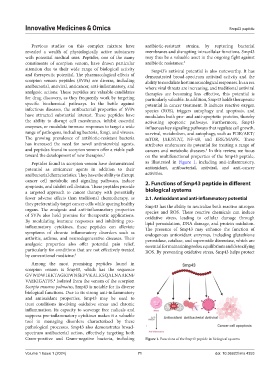
            toward the development of new therapies. 2         on the multifunctional properties of the Smp43 peptide,
              Peptides found in scorpion venom have demonstrated   as illustrated in  Figure  1, including anti-inflammatory,
            potential as anticancer agents in addition to their   antioxidant, antibacterial, antiviral, and anti-cancer
            antibacterial characteristics. They have the ability to disrupt   activities.
            cancer cell metabolic and signaling pathways, induce   2. Functions of Smp43 peptide in different
            apoptosis, and inhibit cell division. These peptides provide
            a targeted approach to cancer therapy with potentially   biological systems
            fewer  adverse  effects  than traditional  chemotherapy,  as   2.1. Antioxidant and anti-inflammatory potential
            they preferentially target cancer cells while sparing healthy   Smp43 has the ability to neutralize both reactive nitrogen
            organs. The analgesic and anti-inflammatory properties   species and ROS. These reactive chemicals can induce
            of SVPs also hold promise for therapeutic applications.   oxidative stress, leading to cellular damage through
            By modulating immune responses and inhibiting pro-  lipid peroxidation, DNA damage, and protein oxidation.
            inflammatory cytokines, these peptides can alleviate   The presence of Smp43 may enhance the function of
            symptoms of chronic inflammatory disorders such as   endogenous antioxidant enzymes, including glutathione
            arthritis, asthma, and neurodegenerative diseases. Their   peroxidase, catalase, and superoxide dismutase, which are
            analgesic properties also offer potential pain relief,   essential for maintaining redox equilibrium and detoxifying
            particularly for conditions that are not effectively treated   ROS. By preventing oxidative stress, Smp43 helps protect
            by conventional medicine. 3
              Among the most promising peptides found in
            scorpion venom is Smp43, which has the sequence
            GVWDWIKKTAGKIWNSEPVKALKSQALNAAKNF
                        4
            VAEKIGATPS.  Isolated from the venom of the scorpion
            Scorpio maurus palmatus, Smp43 is notable for its diverse
            biological functions. Due to its strong anti-inflammatory
            and antioxidant properties, Smp43 may be used to
            treat  conditions  involving  oxidative  stress  and  chronic
            inflammation. Its capacity to scavenge free radicals and
            suppress pro-inflammatory cytokines makes it a valuable
            tool in managing disorders characterized by these
            pathological processes. Smp43 also demonstrates broad-
            spectrum  antibacterial  action,  effectively  targeting  both
            Gram-positive and Gram-negative bacteria, including   Figure 1. Functions of the Smp43 peptide in biological systems


            Volume 1 Issue 1 (2024)                         71                               doi: 10.36922/imo.4353

