


Page 82 - IMO-1-1
P. 82
Innovative Medicines & Omics                                                           Smp43 peptide


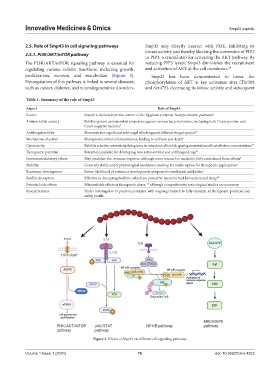
            2.5. Role of Smp43 in cell signaling pathways      Smp43 may directly interact with PI3K, inhibiting its
                                                               kinase activity and thereby blocking the conversion of PIP2
            2.5.1. PI3K/AKT/mTOR pathway
                                                               to PIP3, a crucial step for activating the AKT pathway. By
            The PI3K/AKT/mTOR signaling pathway is essential for   reducing PIP3 levels, Smp43 diminishes the recruitment
            regulating  various  cellular  functions,  including  growth,   and activation of AKT at the cell membrane. 19
            proliferation, survival, and metabolism (Figure  3).   Smp43 has been demonstrated to lower the
            Dysregulation of this pathway is linked to several diseases,   phosphorylation  of  AKT  at  key  activation  sites  (Thr308
            such as cancer, diabetes, and neurodegenerative disorders.   and Ser473), decreasing its kinase activity and subsequent


            Table 1. Summary of the role of Smp43
            Aspect                                                  Role of Smp43
            Source                   Smp43 is derived from the venom of the Egyptian scorpion, Scorpio maurus palmatus 6
            Antimicrobial activity   Exhibits potent antimicrobial properties against various bacterial strains, including both Gram-positive and
                                     Gram-negative bacteria 3
            Antifungal activity      Demonstrates significant antifungal effects against different fungal species 10
            Mechanism of action      Disrupts microbial cell membranes, leading to cell lysis and death 3
            Cytotoxicity             Exhibits selective cytotoxicity, being toxic to microbial cells while sparing mammalian cells at effective concentrations 14
            Therapeutic potential    Potential candidate for developing new antimicrobial and antifungal drugs 13
            Immunomodulatory effects  May modulate the immune response, although more research is needed to fully understand these effects 8
            Stability                Generally stable under physiological conditions, making it a viable option for therapeutic applications 5
            Resistance development   Lower likelihood of resistance development compared to traditional antibiotics 7
            Biofilm disruption       Effective in disrupting biofilms, which are protective layers formed by bacteria and fungi 10
            Potential side effects   Minimal side effects at therapeutic doses,   although comprehensive toxicological studies are necessary
                                                                12
            Research status          Under investigation in preclinical studies, with ongoing research to fully elucidate its therapeutic potential and
                                     safety profile


                                         Figure 3. Effects of Smp43 on different cell signaling pathways


            Volume 1 Issue 1 (2024)                         76                               doi: 10.36922/imo.4353

