


Page 78 - IMO-1-1
P. 78
Innovative Medicines & Omics                                                           Smp43 peptide


            cells from damage, playing a critical role in the prevention
            of diseases linked to oxidative stress, including certain
            cancers,  cardiovascular  diseases  like  atherosclerosis,  and
            neurodegenerative disorders such as Alzheimer’s and
            Parkinson’s diseases. The antioxidant properties of Smp43
            may also contribute to its anti-aging benefits by preserving
            cellular integrity and function, thereby shielding skin cells
            and other tissues from oxidative damage. This protective
            effect may reduce the appearance of aging indicators such
            as wrinkles and age spots. 7
              Smp43 can inhibit pro-inflammatory cytokines,
            including interleukin (IL)-1 beta, IL-6, and tumor
            necrosis factor-alpha (TNF-α), which are key players in
            promoting inflammation. Smp43 may also disrupt critical
            inflammatory signaling pathways, such as mitogen-
            activated protein kinases (MAPK) and nuclear factor kappa-
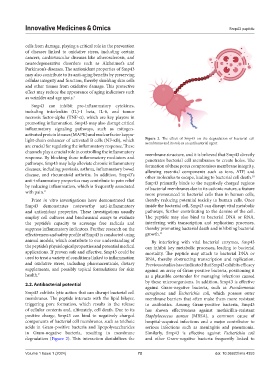
            light-chain enhancer of activated B cells (NF-κB), which   Figure  2. The effect of Smp43 on the degradation of bacterial cell
            are crucial for regulating the inflammatory response. These   membranes and its role as an antibacterial agent
            channels play a crucial role in controlling the inflammatory   membrane structure, and it is believed that Smp43 directly
            response. By blocking these inflammatory mediators and   penetrates bacterial cell membranes to create holes. The
            pathways, Smp43 may help alleviate chronic inflammatory   formation of these pores compromises membrane integrity,
            diseases, including psoriasis, asthma, inflammatory bowel   allowing essential components such as ions, ATP, and
            disease, and rheumatoid arthritis. In addition, Smp43’s   other molecules to escape, leading to bacterial cell death.
                                                                                                            10
            anti-inflammatory properties may contribute to pain relief   Smp43 primarily binds to the negatively charged regions
            by reducing inflammation, which is frequently associated   of bacterial membranes due to its cationic nature, a feature
            with pain. 8                                       more pronounced in bacterial cells than in human cells,
              Prior  in  vitro investigations have demonstrated that   thereby reducing potential toxicity to human cells. Once
            Smp43 demonstrates noteworthy anti-inflammatory    inside the bacterial cell, Smp43 can disrupt vital metabolic
            and antioxidant properties. These investigations usually   pathways, further contributing to the demise of the cell.
            employ cell cultures and biochemical assays to evaluate   The peptide may also bind to bacterial DNA or RNA,
            the peptide’s capacity to scavenge free radicals and   interfering with transcription and replication processes,
            suppress inflammatory indicators. Further research on the   thereby promoting bacterial death and inhibiting bacterial
            effectiveness and safety profile of Smp43 is conducted using   growth. 11
            animal models, which contribute to our understanding of   By interfering with vital bacterial enzymes, Smp43
            the peptide’s physiological properties and potential medical   can inhibit key metabolic processes, leading to bacterial
            applications. If proven safe and effective, Smp43 could be   mortality. The peptide may attach to bacterial DNA or
            used to treat a variety of conditions linked to inflammation   RNA, thereby obstructing transcription and replication.
            and  oxidative  stress,  including  pharmaceuticals,  dietary   Previous studies have indicated that Smp43 exhibits efficacy
            supplements, and  possibly  topical  formulations for  skin   against an array of Gram-positive bacteria, positioning it
            health. 9                                          as a plausible contender for managing infections caused
                                                               by these microorganisms. In addition, Smp43 is effective
            2.2. Antibacterial potential
                                                               against Gram-negative bacteria, such as  Pseudomonas
            Smp43 exhibits lytic action that can disrupt bacterial cell   aeruginosa and  Escherichia coli, which possess outer
            membranes. The peptide interacts with the lipid bilayer,   membrane barriers that often make them more resistant
            triggering pore formation, which results in the release   to antibiotics. Among Gram-positive bacteria, Smp43
            of cellular contents and, ultimately, cell death. Due to its   has shown effectiveness against methicillin-resistant
            positive charge, Smp43 can bind to negatively charged   Staphylococcus  aureus (MRSA), a common cause of
            components of bacterial cell membranes, such as teichoic   hospital-acquired  infections and  a major  contributor to
            acids in Gram-positive bacteria and lipopolysaccharides   serious infections such as meningitis and pneumonia.
            in Gram-negative bacteria, resulting in membrane   Similarly, Smp43 is effective against  Escherichia coli
            degradation (Figure  2). This interaction destabilizes the   and other Gram-negative bacteria frequently linked to


            Volume 1 Issue 1 (2024)                         72                               doi: 10.36922/imo.4353

