


Page 81 - IMO-2-1
P. 81
Innovative Medicines & Omics                                   Impact of lemon essential oil on anthropometrics


            to essential oil was selected to achieve optimal dilution,   The t-student independent sample  t-test was used to
            thereby ensuring the safety of topical application while   assess differences in the means of various anthropometric
            preserving the characteristic fragrance and the potential   measurements between groups. A Mann–Whitney test was
            therapeutic efficacy associated with lemon essential oil.   applied to compare groups, and a Wilcoxon test allowed
            The chosen ratio falls within the recommended range for   comparison between initial and final measures in each
            crucial oil dilution in massage oils, typically between 1%   group. Statistical significance was set at P<0.05.
            and  3%,  aligning  with  established  safety  guidelines.  The
            meticulous preparation of the massage oil aimed to create   3. Results
            a harmonious blend that balances both safety and the   3.1. Sample characterization and initial group
            desired aromatic and therapeutic outcomes. 34      comparisons
            2.8. Intervention                                  The sample, consisting of 26 individuals, was meticulously

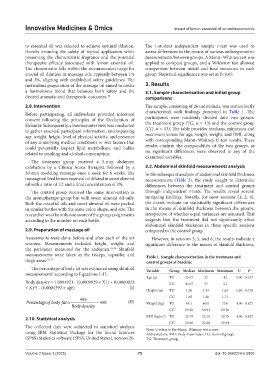
            Before participating, all individuals provided informed   characterized,  with  findings  presented  in  Table  1.  The
            consent following the principles of the Declaration of   participants were randomly  divided  into two groups:
            Helsinki. Subsequently, a baseline interview was conducted   the treatment group (TG, n = 13) and the control group
            to gather essential participant information, encompassing   (CG, n = 13). The table provides medians, minimum and
            age, weight, height, level of physical activity, and presence   maximum values for age, height, weight, and BMI, along
            of any underlying medical conditions or risk factors that   with corresponding Mann–Whitney U-test results. These
            could potentially impact lipid metabolism, and habits   results  confirm  the  comparability of the  two  groups,  as
            related to smoking and alcohol consumption.        no significant differences were observed in any of the
                                                               examined variables.
              The treatment group  received  a 5-min  abdomen
            exfoliation by a Clínica Áurea therapist, followed by a   3.2. Abdominal skinfold measurements analysis
            30-min modeling massage once a week for 6 weeks. The   In the subsequent analysis of abdominal skinfold thickness
            massage utilized lemon essential oil diluted in sweet almond   measurements (Table  2), the study sought to determine
            oil with a ratio of 1:2 and a final concentration of 3%.  differences between the treatment and control groups
              The control group received the same intervention as   through independent  t-tests. The results reveal several
            the aromatherapy group but with sweet almond oil only.   intriguing findings. Notably, for most sessions (1, 2, 4),
            Both the essential oils and sweet almond oil were packed   the  t-tests indicate no statistically significant differences
            in similar bottles with the same color, shape, and size. The   in the means of skinfold thickness between the groups,
            researcher was the only one aware of the group assignments   irrespective of whether equal variances are assumed. This
            according to the number on each bottle.            suggests that the treatment did not significantly affect
                                                               abdominal skinfold thickness in these specific sessions
            2.9. Preparation of massage oil                    compared to the control group.
            Assessments were done before and after each of the six   However, in sessions 3, 5, and 6, the results indicate a
            sessions.  Measurements  included  height,  weight,  and   significant difference in the means of skinfold thickness,
            the perimeter measured for the abdomen. 35,36  Skinfold
            measurements  were  taken  at  the  triceps,  suprailia,  and   Table 1. Sample characterization in the treatment and
            thigh areas. 35,37                                 control groups at baseline
              The percentage of body fat was estimated using skinfold   Variable  Group Median Minimum Maximum  U  P
            measurements’ according to Equations I–II:
                                                               Age (y)   TG     35.67   32      42   1.00 0.127
            Body density = 1.0994921 - (0.0009929 × X1) + (0.0000023     CG     44.67   37      53
            × X1 ) - (0.0001392 × age)                  (I)
                2
                                                               Height (m)  TG   1.59   1.54    1.64  2.50 0.376
                                                                         CG     1.65   1.60    1.71
                                   495
            Percentageof body fat =       − 450        (II)    Weight (kg)  TG  64.1   60.0    73.0  4.00 0.827
                               Bodydensity
                                                                         CG     59.20  64.93   69.20
                                                                      2
            2.10. Statistical analysis                         BMI (kg/m ) TG   25.79  23.16   30.78  4.00 0.827
                                                                         CG     23.96  22.28   25.94
            The collected data were subjected to statistical analysis   Note: U refers to the Mann–Whitney test scores.
            using  IBM  Statistical  Package  for  the  Social  Sciences   Abbreviations: BMI: Body mass index; CG: Control group;
            (SPSS) Statistics software (SPSS, United States), version 20.   TG: Treatment group.


            Volume 2 Issue 1 (2025)                         75                               doi: 10.36922/imo.5893

