


Page 82 - IMO-2-1
P. 82
Innovative Medicines & Omics                                   Impact of lemon essential oil on anthropometrics


            although this difference is highly dependent on the   or BMI across sessions, indicating that the effects of the
            assumption  of  equal  variances.  This  underscores  the   intervention were localized and did not substantially alter
            importance of considering the assumption of equal   overall body composition metrics.
            variances when interpreting the results. In session 3, the   The  CG exhibited  minimal  changes  throughout  all
            mean reduction in the TG was 7.1 mm (±1.2) compared   sessions, reinforcing the hypothesis that the observed
            to the CG, which showed a negligible change of 0.8 mm   trends in TG were explicitly associated with the intervention
            (±0.5). The difference between groups was statistically   involving lemon essential oil.
            significant (P = 0.004). In session 5, the TG demonstrated
            a reduction of 6.9  mm (±1.0), whereas the CG showed   3.4. Wilcoxon test results
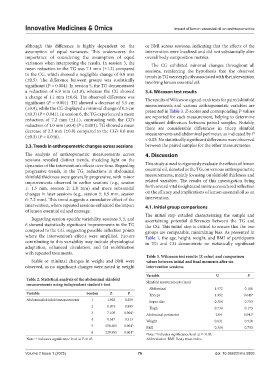
            a change of 1.1 mm (±0.6). The observed difference was   The results of Wilcoxon signed-rank tests for paired skinfold
            significant (P = 0.001). TG showed a decrease of 3.5 cm   measurements and various anthropometric variables are
            (±0.9), while the CG displayed a minimal change of 0.5 cm   presented in Table 3. Z-scores and corresponding P-values
            (±0.3) (P = 0.041). In session 6, the TG experienced a mean   are reported for each measurement, helping to determine
            reduction of  7.2  mm  (±1.1),  contrasting  with the CG’s   significant differences between paired samples. Notably,
            reduction of 1.0 mm (±0.4) (P = 0.001). TG showed a mean   there are considerable differences in tricep skinfold
            decrease of 2.3 mm (±0.8) compared to the CG’s 0.6 mm   measurements and abdominal perimeter, as indicated by P
            (±0.3) (P = 0.046).
                                                               < 0.05. No statistically significant differences were observed
            3.3. Trends in anthropometric changes across sessions  between the paired samples for the other measurements.
            The analysis of anthropometric measurements across   4. Discussion
            sessions  revealed  distinct  trends,  shedding  light  on  the
            dynamics of the intervention’s effects over time. Regarding   This study aimed to rigorously evaluate the effects of lemon
            progressive trends, in the TG, reductions in abdominal   essential oil, denoted as the TG, on various anthropometric
            skinfold thickness were generally progressive, with minor   measurements, mainly focusing on skinfold thickness and
            improvements observed in earlier sessions (e.g., session   related variables. The results of this investigation bring
            1:  1.5  mm, session 2:  2.8  mm) and more substantial   forth several vital insights and invite a considered reflection
            changes in later sessions (e.g., session 5: 6.9 mm, session   on the efficacy and implications of lemon essential oil as an
            6: 7.2 mm). This trend suggests a cumulative effect of the   intervention.
            intervention, where repeated sessions enhanced the impact   4.1. Initial group comparisons
            of lemon essential oil and massage.
                                                               The initial step entailed characterizing the sample and
              Regarding session-specific variability, sessions 3, 5, and   ascertaining potential differences between the TG and
            6 showed statistically significant improvements in the TG   the CG. This initial step is critical to ensure that the two
            compared to the CG, suggesting possible inflection points   groups are comparable, minimizing bias. As presented in
            where the intervention’s effects were amplified. Factors   Table 1, the age, height, weight, and BMI of participants
            contributing to this variability may include physiological   in TG and CG demonstrate no statistically significant
            adaptation, enhanced circulation, and fat mobilization
            with repeated treatments.
                                                               Table 3. Wilcoxon test results (Z value) and comparison
              Stable or minimal changes in weight and BMI were   values between initial and final moments after six
            observed, as no significant changes were noted in weight   intervention sessions
                                                               Variable                      U            P
            Table 2. Statistical analysis of the abdominal skinfold
            measurements using independent student t‑test      Skinfold measurements (mm)
                                                                Abdominal                  −1.572        0.166
            Variable                  Session   Z      P        Triceps                    −1.992        0.046*
            Abdominal skinfold measurements  1  1.928  0.259    Supra iliac                −0.314        0.753
                                        2      0.073  0.805     Thigh                      −0.734        0.173
                                        3      7.109  0.004*   Abdominal perimeter          −2.04        0.041*
                                        4      0.547  0.513    Weight                      −0.631        0.528
                                        5     250.605  0.001*  BMI                         −0.314        0.753
                                        6     229.955  0.001*  Note: *indicates significance level at P<0.05.
            Note: * indicates significance level at P<0.05.    Abbreviation: BMI: Body mass index.


            Volume 2 Issue 1 (2025)                         76                               doi: 10.36922/imo.5893

