


Page 24 - IMO-2-3
P. 24
Innovative Medicines & Omics                                                Progress in antivenom therapy


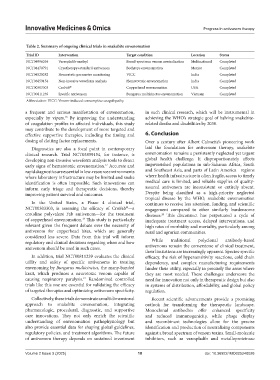
            Table 2. Summary of ongoing clinical trials in snakebite envenomation
            Trial ID      Intervention                 Target condition           Location    Status
            NCT04996264   Varespladib-methyl           Broad-spectrum venom neutralization  Multinational  Completed
            NCT04470791   Cryotherapy+standard antivenom  Bothrops envenomation   Mexico      Completed
            NCT04520282   Hemostatic parameter monitoring  VICC                   India       Completed
            NCT03859154   Non-invasive waveform analysis  Hematotoxic envenomation  India     Completed
            NCT00303303   CroFab ®                     Copperhead envenomation    USA         Completed
            NCT00811239   Specific antivenom           Bungarus multicinctus envenomation  Vietnam  Completed
            Abbreviation: VICC: Venom-induced consumptive coagulopathy.

            a  frequent  and serious manifestation  of  envenomation,   in such clinical research, which will be instrumental in
            especially by vipers.  By improving the understanding   achieving the WHO’s strategic goal of halving snakebite-
                             16
            of coagulation profiles in affected individuals, this study   related deaths and disabilities by 2030.
            may contribute to the development of more targeted and
            effective supportive therapies, including the timing and   6. Conclusion
            dosing of clotting factor replacements.            Over a century after Albert Calmette’s pioneering work

              Diagnostics are also a focal point in contemporary   laid the foundation for antivenom therapy, snakebite
            clinical research. Trial NCT03859154, for instance, is   envenomation remains a persistently neglected yet urgent
            developing non-invasive waveform analysis tools to detect   global health challenge. It disproportionately affects
            early signs of hematotoxic envenomation.  Accurate and   impoverished populations in sub-Saharan Africa, South
                                              17
            rapid diagnostics are essential in low-resource environments   and Southeast Asia, and parts of Latin America—regions
            where laboratory infrastructure may be limited and snake   where health infrastructure is often fragile, access to timely
            identification is often impossible. Such innovations can   medical care is limited, and reliable supplies of quality-
            inform early triage and therapeutic decisions, thereby   assured  antivenom  are  inconsistent  or  entirely  absent.
            improving patient survival and outcomes.           Despite  being classified as  a high-priority neglected
                                                               tropical disease by the WHO, snakebite envenomation
              In the United States, a Phase 4 clinical trial,   continues to receive less attention, funding, and scientific
            NCT00303303,  is  assessing  the  efficacy  of CroFab —a   engagement compared to other similarly burdensome
                                                       ®
            crotaline  polyvalent  Fab  antivenom—for  the  treatment   diseases.  This disconnect has perpetuated a cycle of
                                                                      20
            of copperhead envenomation.  This study is particularly   inadequate treatment access, delayed interventions, and
                                    18
            relevant given the frequent debate over the necessity of   high rates of morbidity and mortality, particularly among
            antivenom  for copperhead  bites,  which are  generally   rural and agrarian communities.
            considered less severe. Data from this trial will inform
            regulatory and clinical decisions regarding when and how   While  traditional  polyclonal  antibody-based
            antivenom should be used in such cases.            antivenoms remain the cornerstone of clinical treatment,
                                                               their limitations are increasingly apparent. Species-specific
              In addition, trial NCT00811239 evaluates the clinical   efficacy, the risk of hypersensitivity reactions, cold chain
            utility and safety of specific antivenoms in treating   dependency, and complex manufacturing requirements
            envenoming by Bungarus multicinctus, the many-banded   hinder their utility, especially in precisely the areas where
            krait, which produces a neurotoxic venom capable of   they are most needed. These challenges underscore the
                                    19
            causing respiratory paralysis.  Randomized controlled   need for innovation not only in therapeutic design but also
            trials like this one are essential for validating the efficacy   in systems of distribution, affordability, and global policy
            of targeted therapies and optimizing antivenom specificity.  regulation.
              Collectively, these trials demonstrate a multidimensional   Recent  scientific  advancements  provide  a  promising
            approach to snakebite envenomation, integrating    outlook for transforming the therapeutic landscape.
            pharmacologic, procedural, diagnostic, and supportive   Monoclonal antibodies offer enhanced specificity
            care innovations. They not only enrich the scientific   and reduced immunogenicity, while phage display
            understanding of envenomation pathophysiology but   and recombinant technologies allow for the precise
            also provide essential data for shaping global guidelines,   identification and production of neutralizing components
            regulatory policies, and treatment algorithms. The future   against a broad spectrum of venom toxins. Small-molecule
            of antivenom therapy depends on sustained investment   inhibitors, such as varespladib and metalloproteinase


            Volume 2 Issue 3 (2025)                         18                          doi: 10.36922/IMO025240026

