


Page 28 - IMO-2-3
P. 28
Innovative Medicines & Omics                            Tyrosine kinases: Structure, mechanism, and therapeutics


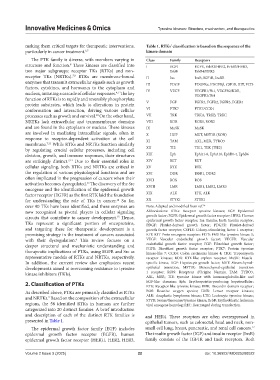
            making them critical targets for therapeutic interventions,   Table 1. RTKs’ classification is based on the sequence of the
            particularly in cancer treatment. 6,7              kinase domain
              The PTK family is diverse, with members varying in   Class  Family    Receptors
            structure and function.  These kinases are classified into   I  EGF/    EGFR, ErbB2/HER2, ErbB3/HER3,
                               8
            two major subgroups: receptor TKs (RTKs) and non-            ErbB       ErbB4/HER3
            receptor TKs  (NRTKs).   RTKs  are membrane-bound   II       Ins        InsR, IGF1R, InsRR
                                7,9
            enzymes that transmit extracellular signals such as growth   III  PDGF  PDGFRα, PDGFRβ, CSF1R, KIT, FLT3
            factors, cytokines, and hormones to the cytoplasm and
            nucleus, initiating a cascade of cellular responses.  The key   IV  VEGF  VEGFR1/Flt1, VEGFR2/KDR,
                                                  4,7
                                                                                    VEGFR3/Flt4
            function of RTKs is to rapidly and reversibly phosphorylate
            protein substrates, which leads to alterations in protein   V  FGF      FGFR1, FGFR2, FGFR3, FGER4
            conformation and interaction, driving various cellular   VI  PTK7       PTK7/CCK4
            processes such as growth and survival.  On the other hand,   VII  TRK   TRKA, TRKB, TRKC
                                          10
            NRTKs  lack  extracellular  and  transmembrane  domains   VIII  ROR     ROR1, ROR2
            and are found in the cytoplasm or nucleus. These kinases   IX  MuSK     MuSK
            are involved in mediating intracellular signals, often in   X  HGF      MET, MST1R (RON)
            response to receptor-dependent activation at the cell   XI   TAM        AXL, MER, TYRO3
            membrane.  While RTKs and NRTKs function similarly
                     7,11
            by regulating crucial cellular processes, including cell   XII  TIE     TIE1, TEK (TIE2)
            division, growth, and immune responses, their structures   XIII  Eph    EphA1-8, EphA10, EphB1-4, EphB6
            are strikingly distinct.  Due to their essential roles in   XIV  RET    RET
                              7,12
            cellular signaling, both RTKs and NRTKs are critical in   XV  RYK       RYK
            the regulation of various physiological functions and are   XVI  DDR    DDR1, DDR2
            often implicated in the progression of cancers when their   XVII  ROS   ROS
            activation becomes dysregulated.  The discovery of the Src   XVIII  LMR  LMR1, LMR2, LMR3
                                      13
            oncogene and the identification of the epidermal growth
            factor receptor (EGFR) as the first RTK laid the foundation   XIX  ALK  LTK, ALK
            for  understanding  the  role  of  TKs  in  cancer.   So  far,   XX  STYK1  STYK1
                                                   14
            over 90 TKs have been identified, and these enzymes are   Note: Adapted and modified from ref. 16
            now recognized as pivotal players in cellular signaling   Abbreviations: RTKs: Receptor tyrosine kinases; EGF: Epidermal
            circuits that contribute to cancer development.  Hence,   growth factor; EGFR: Epidermal growth factor receptor; HER2: Human
                                                   15
                                                               epidermal growth factor receptor; Ins: Insulin; InsR: Insulin receptor;
            TKs represent a significant portion of oncoproteins,   PDGF: Platelet-derived growth factor; PDGFR: Platelet-derived
            and targeting these for therapeutic development is a   growth factor receptor; CSF1R: Colony-stimulating factor 1 receptor;
            promising strategy in the treatment of cancers associated   KIT: KIT Proto-oncogene receptor; FLT3: FMS-like tyrosine kinase 3;
            with their dysregulation.  This review focuses on a   VEGF: Vascular endothelial growth factor; VEGFR: Vascular
                                 6
            deeper structural and mechanistic understanding and   endothelial growth factor receptor; FGF: Fibroblast growth factor;
                                                               FGFR: Fibroblast growth factor receptor; PTK7: Protein tyrosine
            therapeutic implications of PTKs, using EGFR and Src as   kinase-like 7; CCK4: Colon carcinoma kinase 4; TRK: Tropomyosin
            representative models of RTKs and NRTKs, respectively.   receptor  kinases;  ROR:  RTK-like  orphan  receptor;  MuSK:  Muscle-
            In  addition,  the  current  review  also  emphasizes  recent   specific kinase, HGF: Hepatocyte growth factor; MET: Mesenchymal-
            developments aimed at overcoming resistance to tyrosine   epithelial transition; MST1R: Mesenchymal-epithelial transition
            kinase inhibitors (TKIs).                          1 receptor; RON: Recepteur d’Origine Nantais; TAM: TYRO3,
                                                               AXL, MER; TIE: tyrosine kinase with immunoglobulin-like and
            2. Classification of PTKs                          EGF-like  domains; Eph: Erythropoietin-producing hepatocellular;
                                                               RYK: Receptor like tyrosine kinase; DDR: Discoidin domain receptor;
            As described above, PTKs are primarily classified as RTKs   ROS: Reactive oxygen species; LMR: Lemur receptor kinases;
            and NRTKs.  Based on the composition of the extracellular   ALK: Anaplastic lymphoma kinase; LTK: Leukocyte tyrosine kinase;
                      9
                                                               STYK: Serine/threonine/tyrosine kinase; ErbB: Erythroblastic leukemia
            regions, the 58 identified RTKs in humans are further   viral oncogene homolog; RET: Rearranged during transfection.
            categorized into 20 distinct families. A brief introduction
            and description of each of the distinct RTK families is   and HER4. These receptors are often overexpressed in
            presented in Table 1.                              epithelial tumors, such as colorectal, head and neck, non-
                                                                                                            17
              The epidermal growth factor family (EGF) includes   small cell lung, breast, pancreatic, and renal cell cancers.
            epidermal growth factor receptor (EGFR), human     The insulin growth factor (IGF) and insulin receptor (InsR)
            epidermal growth factor receptor (HER)1, HER2, HER3,   family consists of the IGF1R and InsR receptors. Both

            Volume 2 Issue 3 (2025)                         22                          doi: 10.36922/IMO025200022

