


Page 33 - IMO-2-3
P. 33
Innovative Medicines & Omics                            Tyrosine kinases: Structure, mechanism, and therapeutics


                         A                                            B


                                  C                     D


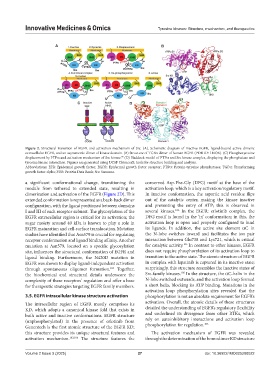
            Figure  2.  Structural transition  of EGFR  and activation mechanism of  Src. (A).  Schematic  diagram  of  inactive  EGFR, ligand-bound active dimeric
            extracellular EGFR, and an asymmetric dimer of kinase domain. (B) Structure of TGFa dimer of human EGFR (PDB ID: 1MOX). (C) Phosphotyrosine
                                                     99
            displacement by PTPa and activation mechanism of Src kinase.  (D) Haddock model of PTPa and Src kinase complex, displaying the phosphatase and
            tyrosine kinase interaction. Figures are generated using UCSF ChimeraX: tools for structure building and analysis.
            Abbreviations: EFR: Epidermal growth factor; EGFR: Epidermal growth factor receptor; PTPa: Protein-tyrosine phosphatases; TGFa: Transforming
            growth factor alpha; PDB: Protein Data Bank; Src: Sarcoma.

            a significant conformational change, transitioning the   conserved Asp-Phe-Gly (DFG) motif at the base of the
            module  from  tethered  to  extended  state,  resulting  in   activation loop, which is a key activation/regulatory motif.
            dimerization and activation of the EGFR (Figure 2D). This   In  inactive  conformation,  the  aspartic  acid  residue  flips
            extended conformation is represented as a back-back dimer   out of the catalytic center, making the kinase inactive
            configuration, with the ligand positioned between domains   and preventing the entry of ATP; this is observed in
                                                                            106
            I and III of each receptor subunit. The glycosylation of the   several kinases.  In the EGFR:  erlotinib complex, the
            EGFR extracellular region is critical for its activation; the   DFG motif is found in the ‘in’ conformation; in this, the
            sugar moiety around 40 kDa is known to play a role in   activation loop is open and properly configured to bind
            EGFR maturation and cell-surface translocation. Mutation   its ligands. In addition, the active site element  aC in
            studies have identified that Asn579 is crucial for regulating   the N-lobe switches inward and facilitates the ion pair
            receptor conformation and ligand binding affinity. Another   interaction between Glu738 and Lys721, which is critical
                                                                               105
            mutation at Asn579, located on a specific glycosylation   for catalytic activity.  In contrast to other kinases, EGFR
            site, influences the structural conformation of EGFR and   does not require phosphorylation of its activation loop to
            ligand binding. Furthermore, the N420D mutation in   transition to the active state. The atomic structure of EGFR
            EGFR was shown to display ligand-independent activation   in complex with lapatinib is captured in its inactive state;
            through spontaneous oligomer formation.  Together,   surprisingly, this structure resembles the inactive states of
                                                105
                                                                              105
            the biochemical and structural details underscore the   Src-family kinases.  In the structure, the aC-helix in the
            complexity of these receptors’ regulation and offer a base   N-lobe switched outwards, and the activation loop formed
            for therapeutic strategies targeting EGFR family members.  a short helix, blocking its ATP binding. Mutations in the
                                                               activation loop phosphorylation sites revealed that the
            3.5. EGFR intracellular kinase structure activation  phosphorylation is not an absolute requirement for EGFR’s
            The intracellular region of EGFR mostly comprises its   activation. Overall, the atomic details of these structures
            KD, which adopts a canonical kinase fold that exists in   detailed the understanding of EGFR’s regulatory flexibility
            both active and inactive conformations. EGFR structure   and underlined its divergence from other RTKs, which
            (unphosphorylated) in  the  presence  of erlotinib from   rely on autoinhibitory interactions and activation loop
                                                                                        105
            Genentech is the first atomic structure of the EGFR KD;   phosphorylation for regulation.
            this structure provides its unique structural features and   The activation mechanism of EGFR was revealed
            activation mechanism. 103,106  The structure features the   through the determination of the homodimer KD structure


            Volume 2 Issue 3 (2025)                         27                          doi: 10.36922/IMO025200022

