


Page 35 - IMO-2-3
P. 35
Innovative Medicines & Omics                            Tyrosine kinases: Structure, mechanism, and therapeutics


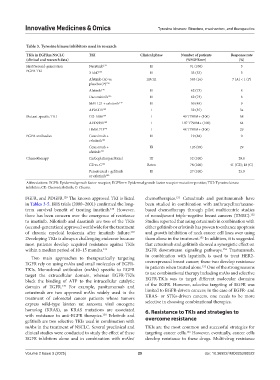
            Table 3. Tyrosine kinase inhibitors used in research
            TKIs in EGFRm NSCLC        TKI                   Clinical phase   Number of patients   Response rate
            (clinical and research data)                                        (%EGFRm+)              (%)
            First/Second-generation    Neratinib 132             II               91 (100)             3
            EGFR TKI                   XL647 133                 II               33 (53)              3
                                       Afatinib (A) vs.        IIB/III            585 (16)          7 (A) < 1 (P)
                                       placebo (P) 134
                                       Afatinib 135              II               62 (73)              8
                                       Dacomitinib 136           II               62 (73)              8
                                       MM-121 + erlotinib 137    II               50 (48)              9
                                       AP26113 138               I                32 (35)              3a
            Mutant-specific TKI        CO-1686 139               I             40 T790M+ (100)         58
                                       AZD9291 140               I            107 T790M+ (100)         64
                                       HM61713 141               I             48 T790M+ (100)         29
            EGFR antibodies            Cetuximab +               II               19 (84)              0
                                       erlotinib 142
                                       Cetuximab +               IB               126 (98)             29
                                       afatinib 143
            Chemotherapy               Carboplatin/paclitaxel    III              52 (100)            28.8
                                       CE vs. C 144             Retro             78 (100)         41 (CE); 18 (C)
                                       Pemetrexed + gefitinib    II               27 (100)            25.9
                                       or erlotinib 145
            Abbreviations: EGFR: Epidermal growth factor receptor; EGFRm+: Epidermal growth factor receptor mutation-positive; TKI: Tyrosine kinase
            inhibitor; CE: Chemo/erlotinib; C: Chemo.

            FGFR, and PDGFR.  The known approved TKI is listed   chemotherapies.  Cetuximab and panitumumab have
                            129
                                                                            151
            in Tables 3-5. IRIS trials (2000–2001) confirmed the long-  been studied in combination with anthracycline/taxane-
            term survival benefit of treating imatinib.  However,   based chemotherapy through pilot multicentric studies
                                                130
            there has been concern over the emergence of resistance   of neoadjuvant triple-negative breast cancers (TNBC).
                                                                                                            152
            to imatinib. Nilotinib and dasatinib are two of the TKIs   Studies reported that using cetuximab in combination with
            (second-generation) approved worldwide for the treatment   either gefitinib or erlotinib has proven to enhance apoptosis
            of  chronic  myeloid  leukemia  after  imatinib  failure.    and growth inhibition of neck cancer cell lines over using
                                                         130
            Developing TKIs is always a challenging endeavor because   them alone in the treatment.  In addition, it is suggested
                                                                                      153
            most patients develop acquired resistance against TKIs   that cetuximab and gefitinib showed a synergistic effect on
            within a median period of 10–15 months. 131        EGFR downstream signaling pathways.  Trastuzumab,
                                                                                                154
              Two main approaches to therapeutically targeting   in combination with lapatinib, is used to treat HER2-
            EGFR rely on using mAbs and small molecules of EGFR-  overexpressed breast cancer; these two develop resistance
                                                                                       155
            TKIs.  Monoclonal  antibodies  (mAbs) specific  to EGFR   in patients when treated alone.  One of the strong reasons
            target the extracellular domain, whereas EGFR-TKIs   to use combinational therapy including mAbs and selective
            block the binding of ATP to the intracellular catalytic   EGFR-TKIs was to target different molecular domains
            domain of EGFR.  For example, panitumumab and      of the EGFR. However, selective targeting of EGFR was
                           149
            cetuximab are two approved mAbs widely used in the   limited to EGFR-driven cancers; in the case of EGFR- and
            treatment of colorectal cancer patients whose tumors   KRAS-  or STKs-driven cancers, one needs to be more
            express wild-type kirsten rat sarcoma viral oncogene   selective in choosing combinational therapies.
            homolog (KRAS), as KRAS mutations are associated   6. Resistance to TKIs and strategies to
            with  resistance  to  anti-EGFR  therapies.   Erlotinib  and   overcome resistance
                                             150
            gefitinib are two selective TKIs used in combination with
            mAbs in the treatment of NSCLC. Several preclinical and   TKIs are the most common and successful strategies for
            clinical studies were conducted to study the effect of these   targeting cancer cells.  However, eventually, cancer cells
                                                                                156
            EGFR inhibitors alone and in combination with mAbs/  develop resistance to these drugs. Multi-drug resistance

            Volume 2 Issue 3 (2025)                         29                          doi: 10.36922/IMO025200022

