


Page 32 - IMO-2-3
P. 32
Innovative Medicines & Omics                            Tyrosine kinases: Structure, mechanism, and therapeutics


                         A                                     D


                                               C


                                                                   E


                         B


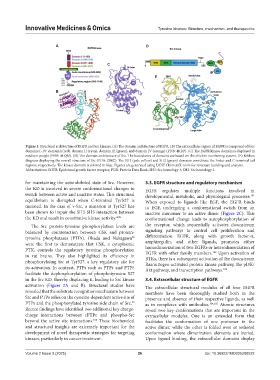
            Figure 1. Structural architecture of EGFR and Src kinases. (A) The domain architecture of EGFR. (B) The extracellular region of EGFR is composed of four
            domains I–IV: domain I (red), domain II (cyan), domain III (green), and domain IV (orange) (PDB: 4KRP). (C) The EGFR kinase domain is displayed in
            medium purple (PDB: 4LQM). (D) The domain architecture of Src. The boundaries of domains are based on the chicken numbering system. (E) Ribbon
            diagram displaying the overall structure of Src (PDB: 2SRC). The SH3 (pale yellow) and SH2 (green) domains coordinate the linker and C-terminal tail
            regions, respectively. The kinase domain is colored in blue. Figures are generated using UCSF ChimeraX: tools for structure building and analysis.
            Abbreviations: EGFR: Epidermal growth factor receptor; PDB: Protein Data Bank; SH3: Src homology 3; SH2: Src homology 2.


            for maintaining the autoinhibited state of Src. However,   3.3. EGFR structure and regulatory mechanism
            the KD is involved in severe conformational changes to   EGFR regulates multiple functions involved in
            switch between active and inactive states. This structural   developmental, metabolic, and physiological processes.
                                                                                                            101
            equilibrium is disrupted when C-terminal Tyr527 is   When exposed to ligands like EGF, the EGFR binds
            mutated. In the case of v-Src, a mutation at Tyr527 has   to EGF, undergoing a conformational switch from an
            been shown to impair the SH2-SH3 interaction between   inactive monomer to an active dimer (Figure  2C). This
            the KD and result in constitutive kinase activity. 4,89  conformational change leads to autophosphorylation of
              The Src protein-tyrosine phosphorylation levels are   the receptor, which sequentially activates downstream
            balanced by counteraction between CSK and protein-  signaling pathways to  control  cell  proliferation and
            tyrosine phosphatases (PTPs). Okada and Nakagawa    differentiation. EGFR, along with growth factor-a,
                                                         98
            were the first to demonstrate that CSK, a cytoplasmic   amphiregulin, and other ligands, promotes either
            PTK,  controls  the  regulatory  tyrosine  phosphorylation   homodimerization of two EGFRs or heterodimerization of
                                                                                           102
            in rat brains. They also highlighted its efficiency in   EGFR with other family members.  Upon activation of
                                                               RTKs, there is a subsequent activation of the downstream
            phosphorylating Src at Tyr527, a key regulatory site for   Ras/mitogen-activated protein kinase pathway, the pI3K/
            its activation. In contrast, PTPs such as PTPε and PTPε   Akt pathway, and transcription pathways. 103
            facilitate  the  dephosphorylation  of  phosphotyrosine  527
            in the Src KD, thereby displacing it, leading to Src kinase   3.4. Extracellular structure of EGFR
            activation (Figure 2A and  B). Structural studies have   The  extracellular  structural  modules  of  all  four  EGFR
            revealed that the substrate recognition mechanism between   members have been thoroughly studied both in the
            Src and PTPs relies on the cysteine-dependent active site of   presence and absence of their respective ligands, as well
                                                         99
            PTPs and the phosphorylated tyrosine side chain of Src.    as in complexes with antibodies. 104,105  Atomic structures
            Recent findings have identified two additional key charge-  reveal two key conformations that are important in the
            charge interactions between rPTPε and phospho-Src   extracellular modules. One is an extended form that
            beyond the active site interactions.  These biochemical   facilitates the conformation of one protomer in the
                                         100
            and structural insights are extremely important for the   active  dimer, while  the other is  folded over or tethered
            development of novel therapeutic strategies for targeting   conformation  where  dimerization  elements  are  buried.
            kinases, particularly in cancer treatment.         Upon ligand binding, the extracellular domains display


            Volume 2 Issue 3 (2025)                         26                          doi: 10.36922/IMO025200022

