


Page 31 - IMO-2-3
P. 31
Innovative Medicines & Omics                            Tyrosine kinases: Structure, mechanism, and therapeutics


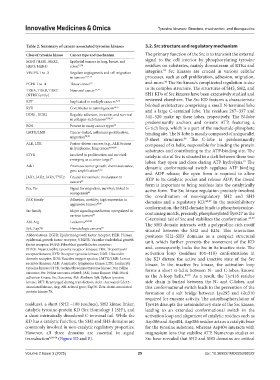
            Table 2. Summary of cancer-associated tyrosine kinases  3.2. Src structure and regulatory mechanism
            Class of tyrosine kinase   Cancer type and mechanism  The primary function of the Src is to transmit the external
            EGFR (HER1, HER2,   Epithelial tumors in lung, breast, and   signal to the cell interior by phosphorylating tyrosine
            HER3, HER4)        colon 17,70                     residues on substrates, mainly downstream of RTKs and
                                                                      95
            VEGFR-1 to -3      Regulate angiogenesis and cell migration   integrins.  Src kinases are crucial in various cellular
                               in tumors 21,71,72              processes, such as cell proliferation, adhesion, migration,
                                                                       42
            FGFR-1 to -4       Tissue cancer 22                and more.  The Src kinase’s complicated regulation is due
            TRKA, TRKB, TRKC   Neuronal cancer 25,73           to its complex structure. The structures of SH3, SH2, and
            (NTRK family)                                      SH1 KDs of Src kinases have been extensively studied and
            RET                Implicated in multiple cancers 35,74  reviewed elsewhere. The Src KD features a characteristic
            RYK                Contributes to tumorigenesis 36,75  bilobed architecture comprising a small N-terminal lobe
                                                               and a large C-terminal lobe. The residues 267–337 and
            DDR1, DDR2         Regulate adhesion, invasion, and survival   341–520 make up these lobes, respectively. The N-lobe
                               in collagen-rich tumors 37,76,77  predominantly anchors and orients ATP, featuring a
            ROS                Present in many cancer types 38  G-rich loop, which is a part of the nucleotide-phosphate
            LMTK/LMR           Cancer-linked; influences proliferation,   binding site. The N-lobe is mostly composed of antiparallel
                               migration 78,79                 β-sheet structures.  The  C-lobe  is predominantly
                                                                               96
            ALK, LTK           Fusion-driven cancers (e.g., ALK fusions   composed of a helix, responsible for binding the protein
                               in lymphoma, lung cancer 40,41,80  substrates and contributing to the ATP-binding site. The
            STYK               Involved in proliferation and survival;   catalytic site of Src is situated in a cleft between these two
                               emerging as a cancer target 81  lobes; they open and close during ATP hydrolysis.  The
                                                                                                         97
            Ack1               Promotes tumor growth, chemoresistance,   dynamic conformational switch regulates ATP binding
                               gene amplification 45,82        and ADP release; the open form is required to allow
            JAK1, JAK2, JAK3, TYK2  Crucial for immune modulation in   ATP to its catalytic pocket and release ADP; the closed
                               cancers 83                      form is important to bring residues into the catalytically
            Fes, Fer           Signal for migration, survival; linked to   active form. The Src kinase regulation precisely involved
                               oncogenesis 84
                                                               the coordination of non-regulatory SH2 and SH3
            FAK family         Adhesion, motility; high expression in   domains and a regulatory KD. 89,97  In the autoinhibitory
                               aggressive tumors 85,86
            Src family         Major signaling mediators; upregulated in   conformation, the SH2 domain binds to phosphotyrosine-
                                                               containing motifs, precisely, phosphorylated Tyr527 in the
                               various tumors 60                                                           89,97
            Abl, Arg           Leukemia 67,87,88               C-terminal tail of Src and stabilizes the conformation.
                                                               The SH3 domain interacts with a polyproline-rich motif
            Syk, Zap70         Hematologic cancers 69          situated between the SH2 and KDs. This interaction
            Abbreviations: EGFR: Epidermal growth factor receptor; HER: Human   positions SH2–SH3 domains as a compact structural
            epidermal growth factor receptor; VEGFR: Vascular endothelial growth   unit, which further  prevents the movement  of  the  KD
            factor receptor; FGFR: Fibroblast growth factor receptor;
            NTRK: Neurotrophic tyrosine receptor kinases; TRK: Tropomyosin   and, consequently, locks the Src in its inactive state. The
            receptor kinases; RYK: Receptor tyrosine kinase; DDR: Discoidin   activation  loop  (residues  404–418)  conformations  in
            domain receptor; ROS: Reactive oxygen species; LMTK/LMR: Lemur   the KD dictate the active and inactive state of the Src
            receptor kinases; ALK: Anaplastic lymphoma kinase; LTK: Leukocyte   kinase. In the inactive  Src  kinase, the activation loop
            tyrosine kinase; STYK: Serine/threonine/tyrosine kinase; Fes: Feline   forms a short  a-helix between N-  and C-lobes, known
            sarcoma; Fer: Feline sarcoma-related; JAK: Janus Kinase; FAK: Focal   89,97
            adhesion kinase; Src: Sarcoma; Abl: Abelson; Syk: Spleen tyrosine   as the A-loop helix.   As a result, the Tyr416 residue
            kinase; RET: Rearranged during transfection; Ack1: Activated Cdc42-  side chain is buried between the N-  and C-lobes, and
            associated kinase; Arg: Abl-related gene; Zap70: Zeta-chain-associated   this conformational switch leads to the prevention of the
            protein kinase 70.                                 formation of a salt bridge between Lys295 and Glu310
                                                               required for enzyme activity. The autophosphorylation of
            residues), a short (SH2 ~100 residues), SH2 kinase linker,   Tyr416 disrupts the autoinhibitory state of the Src kinase,
            catalytic tyrosine-protein KD (Src Homology 1 [SH ), and   leading  to  an  extended  conformational  switch  in  the
                                                     1
            a short intrinsically disordered C-terminal tail. While the   activation loop and alignment of catalytic residues such as
            KD has a catalytic function, the SH2 and SH3 domains are   Asp386 and Asp404. Asp386 residue acts as a catalytic base
            commonly involved in non-catalytic regulatory properties.   for the tyrosine substrate, whereas Asp404 interacts with
            However, all three domains are essential in signal   magnesium ions that stabilize ATP. Numerous studies on
            transduction 8,90-94  (Figure 1D and E).           Src have revealed that SH2 and SH3 domains are critical


            Volume 2 Issue 3 (2025)                         25                          doi: 10.36922/IMO025200022

