


Page 91 - IMO-2-3
P. 91
Innovative Medicines & Omics                                             Bioactivities of Commelina diffusa


            saline, 10 mL/kg body weight, orally), standard (morphine,   animals were treated with a 10% glucose solution (2 mg/kg
            2 mg/kg body weight, intraperitoneally), crude methanolic   body weight; Eskayef Pharmaceuticals Ltd., Bangladesh).
            extract of  C. diffusa (100  and 200  mg/kg),  chloroform-  After 30, 90, and 150 min, blood was collected by pricking
            soluble fraction (100 and 200 mg/kg), and petroleum ether-  the tail vein, and the glucose level was measured using a
            soluble fraction (100 and 200 mg/kg). At time zero, the test   glucometer (Get Well Limited, Bangladesh). 24
            samples and control treatments were administered orally
            using a feeding needle. Tail-flick latency was recorded at 30   2.8. Statistical analysis
            and 60 min post-administration for each mouse, and the   Data were analyzed using one-way analysis of variance
            average latency for each group was calculated.     followed by Tukey’s  post  hoc test. All statistical analyses
                                                               were performed using GraphPad Prism version  8.0.2
            2.6. Peripheral analgesic activity                 (GraphPad Software, USA).
            The acetic acid-induced writhing method was used to
            assess the peripheral analgesic efficacy.  Pain was induced   3. Results
                                           21
            in the experimental animals via intraperitoneal injection   3.1. Antimicrobial results
            of acetic acid, leading to writhing behavior, defined as
            contraction of the abdomen and elongation of the body.   The methanol, petroleum ether, and chloroform-
            The analgesic effect of the test samples and the control was   soluble fractions of  C.diffusa exhibited low to moderate
            assessed by comparing their writhing inhibition relative   antimicrobial activity against most of the tested organisms
            to the standard drug. A total of 40 mice were randomly   (Table 1). At a concentration of 200 µg/disc, the zone of
            divided into `treatment and control groups as described   inhibition generated by each of these four extracts varied
            in Section 2.5. However, the standard group received   from 7.0  mm to 14.0  mm, while the standard disc of
            diclofenac sodium 10 mg/kg BW. At time zero, the mice   kanamycin (30 µg/disc) produced 17–27 mm zones. The
            received the respective treatments orally through a feeding   highest antibacterial activity was noted for the chloroform
            needle. After  40  min,  all  animals  were  administered  1%   extract against Bacillus subtilis.
            acetic acid intraperitoneally. Five minutes post-injection,   These results suggest that the chloroform and
            the number of writhes was recorded for each mouse over   methanol extracts of C. diffusa have antimicrobial activity,
            a 10-min period. The inhibition of writhing was calculated   supporting its traditional medicinal use. Our result aligns
            as a percentage using Equation I.                  with  previous  findings  on  the  antimicrobial  potential  of
                                                               this plant.  While the inhibitory effects were not as potent
                                                                       25
                        Average       Average                  as standard antibiotics, the observed zones of inhibition
                        writhingof  −  writhingof              suggest that the plant possesses bioactive compounds with
                        control       samplle
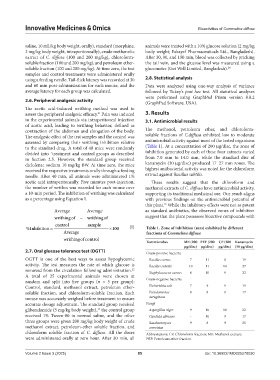
            %Inhibition =                       ×100    (I)    Table 1. Zone of inhibition (mm) exhibited by different
                            Average                            fractions of Commelina diffusa
                            writhingof control
                                                               Test microbes   ME (200  PEF (200  CF (200  Kanamycin
                                                                               µg/disc)  µg/disc)  µg/disc) (30 µg/disc)
            2.7. Oral glucose tolerance test (OGTT)            Gram-positive bacteria
            OGTT is one of the best ways to assess hypoglycemic   Bacillus cereus  7    11      8       19
            activity. The test measures the rate at which glucose is   Bacillus subtilis  10  11  14    27
            removed from the circulation following administration.    Staphylococcus aureus  8  10  9   22
                                                         22
            A total of 25 experimental animals were chosen at
            random and split into five groups (n = 5 per group):   Gram-negative bacteria
            Control, standard, methanol extract, petroleum ether-  Escherichia coli  7   9      9       19
            soluble fraction, and chloroform-soluble fraction. Each   Pseudomonas   8    8      9       17
            mouse was accurately weighed before treatment to ensure   aeruginosa
            accurate dosage adjustment. The standard group received   Fungi
            glibenclamide (5 mg/kg body weight),  the control group   Aspergillus niger  9  10  10      22
                                          23
            received 1% Tween-80 in normal saline, and the other   Candida albicans  -  10      9       17
            three groups were given 200 mg/kg body weight of crude   Saccharomyces   9   8      9       25
            methanol extract, petroleum-ether soluble fraction, and   cerevisiae
            chloroform soluble fraction of  C. diffusa. All the doses   Abbreviations: CF: Chloroform fraction; ME: Methanol extract;
            were administered orally at zero hour. After 30  min, all   PEF: Petroleum ether fraction.


            Volume 2 Issue 3 (2025)                         85                          doi: 10.36922/IMO025270030

